

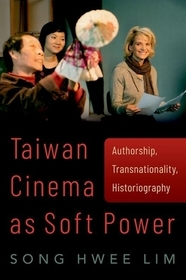
Taiwan Cinema as Soft Power
Authorship, Transnationality, Historiography
- Publisher's listprice GBP 105.00
-
50 163 Ft (47 775 Ft + 5% VAT)
The price is estimated because at the time of ordering we do not know what conversion rates will apply to HUF / product currency when the book arrives. In case HUF is weaker, the price increases slightly, in case HUF is stronger, the price goes lower slightly.
- Discount 10% (cc. 5 016 Ft off)
- Discounted price 45 147 Ft (42 998 Ft + 5% VAT)
Subcribe now and take benefit of a favourable price.
Subscribe
50 163 Ft

Availability
Estimated delivery time: In stock at the publisher, but not at Prospero's office. Delivery time approx. 3-5 weeks.
Not in stock at Prospero.
Why don't you give exact delivery time?
Delivery time is estimated on our previous experiences. We give estimations only, because we order from outside Hungary, and the delivery time mainly depends on how quickly the publisher supplies the book. Faster or slower deliveries both happen, but we do our best to supply as quickly as possible.
Product details:
- Publisher OUP USA
- Date of Publication 18 February 2022
- ISBN 9780197503379
- Binding Hardback
- No. of pages244 pages
- Size 241x159x18 mm
- Weight 435 g
- Language English 238
Categories
Short description:
Why has Taiwanese film been so appealing to film directors, critics, and audiences across the world? This book argues that because Taiwan is a nation without hard political and economic power, cinema becomes a form of soft power tool that Taiwan uses to attract global attention, to gain support, and to build allies. Author Song Hwee Lim shows how this goal has been achieved by Taiwanese directors whose films win the hearts and minds of foreign audiences to make Taiwan a major force in world cinema.
MoreLong description:
Why has Taiwanese film been so appealing to film directors, critics, and audiences across the world? This book argues that because Taiwan is a nation without hard political and economic power, cinema becomes a form of soft power tool that Taiwan uses to attract global attention, to gain support, and to build allies. Author Song Hwee Lim shows how this goal has been achieved by Taiwanese directors whose films win the hearts and minds of foreign audiences to make Taiwan a major force in world cinema.
The book maps Taiwan's cinematic output in the twenty-first century through the three keywords in the book's subtitle-authorship, transnationality, historiography. Its object of analysis is the legacy of Taiwan New Cinema, a movement that begun in the early 1980s that has had a lasting impact upon filmmakers and cinephiles worldwide for nearly forty years. By examining case studies that include Hou Hsiao-hsien, Ang Lee, and Tsai Ming-liang, this book suggests that authorship is central to Taiwan cinema's ability to transcend borders to the extent that the historiographical writing of Taiwan cinema has to be reimagined. It also looks at the scaling down of soft power from the global to the regional via a cultural imaginary called "little freshness", which describes films and cultural products from Taiwan that have become hugely popular in China and Hong Kong. In presenting Taiwan cinema's significance as a case of a small nation with enormous soft power, this book hopes to recast the terms and stakes of both cinema studies and soft power studies in academia.
Table of Contents:
Acknowledgements
Notes on Chinese Romanization, translation, and citation
List of Illustrations
List of Tables
Introduction Cinema as Soft Power, Soft Power as Method
Chapter 1 The Historiographical Turn: Documenting Taiwan New Cinema as Cross-cultural Cinephilia
Chapter 2 The Aural Turn: Hou Hsiao-hsien's Gendered and Material Voices
Chapter 3 The Medial Turn: Tsai Ming-liang's Slow Walk to the Museum
Chapter 4 The Industrial Turn: Ang Lee's Transpacific Crossings as Cultural Brokerage
Chapter 5 The Affective Turn: "Little Freshness" as Regional Soft Power
Epilogue Alien Resurrection or, the Afterlives of Taiwan New Cinema
Filmography
Glossary of Chinese Characters
Works Cited
Index

