

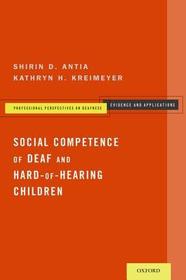
Social Competence of Deaf and Hard-of-Hearing Children
Series: Professional Perspectives On Deafness: Evidence and Applications;
- Publisher's listprice GBP 48.49
-
23 166 Ft (22 062 Ft + 5% VAT)
The price is estimated because at the time of ordering we do not know what conversion rates will apply to HUF / product currency when the book arrives. In case HUF is weaker, the price increases slightly, in case HUF is stronger, the price goes lower slightly.
- Discount 10% (cc. 2 317 Ft off)
- Discounted price 20 849 Ft (19 856 Ft + 5% VAT)
Subcribe now and take benefit of a favourable price.
Subscribe
23 166 Ft

Availability
printed on demand
Why don't you give exact delivery time?
Delivery time is estimated on our previous experiences. We give estimations only, because we order from outside Hungary, and the delivery time mainly depends on how quickly the publisher supplies the book. Faster or slower deliveries both happen, but we do our best to supply as quickly as possible.
Product details:
- Publisher OUP USA
- Date of Publication 9 July 2015
- ISBN 9780199957736
- Binding Paperback
- No. of pages304 pages
- Size 155x236x12 mm
- Weight 408 g
- Language English 0
Categories
Short description:
Hearing loss, with its resulting communication challenges, can impede the development of social skills and restrict social relationships of deaf and hard-of-hearing (DHH) children. Social Competence of Deaf and Hard-of-Hearing Children is addressed to parents, educators, and researchers interested in the development, assessment, and promotion of social competence in DHH children.
MoreLong description:
Social Competence of Deaf and Hard-of-Hearing Children addresses the development, assessment, and promotion of social competence in children who are deaf or hard-of-hearing (DHH). Most children readily develop social competence through the mutually dependent development of social skills and social relationships. Why then write a book on the social competence of DHH children? Hearing loss, with its resulting communication challenges, has the potential to impede the development of social skills and restrict social relationships. In this volume, Shirin D. Antia and Kathryn H. Kreimeyer highlight multiple strategies that teachers, families, and community members can utilize to promote the social competence of DHH children.
The authors approach this topic by first describing the development and expression of social competence in infants, as well as in preschool- and school-age hearing and DHH children. Socially competent children display a flexible repertoire of social behaviors that are appropriately utilized in varying social situations and which further children's social goals. Since social competence develops initially through interactions between infants and their caretakers, a primary consideration for children with hearing loss is that the infant and caretaker share a common communication approach to facilitate early interaction. As infants become preschool age, opportunities for interactions with other children increase and social interactions revolve around play. The development of interactive and of pretend play requires children to communicate with one another to assume roles, share fantasies, and solve social conflicts. DHH children must develop communication skills to participate in interactive play, and hearing children may need guidance to successfully engage with DHH peers. For school-age children, the importance of peer acceptance increases; DHH children need supportive situations both within and outside of school to interact with peers, develop friendships, and refine the social behaviors that promote peer acceptance.
The authors present a variety of practical ways to assess the social competence of DHH children. They emphasize the role of assessment in identifying social strengths and needs to establish a basis for any necessary intervention. They then present ways to promote social competence, with a separate focus on strategies appropriate for young DHH children and for school-age DHH children. For both age groups, the authors address the role of families, professionals, schools, and communities in helping children develop the skills needed to become socially competent individuals. This book will be a valuable resource for the parents and families of DHH children, for the general and special educators who teach these children, and for the researchers who describe development and evaluate the effectiveness of strategies to promote the social competence of DHH children.
The book is a must read
Table of Contents:
Table of Contents
Chapter 1: Why Write a Book on the Social Competence of Deaf and Hard-of-Hearing (DHH) Children?
Chapter 2: Social Competence and Its Importance
Chapter 3: Social Competence of Young DHH Children
Chapter 4: Social Competence of School-Age Children
Chapter 5: Factors Influencing Social-Competence Development and Outcomes
Chapter 6: A Primer on Understanding Instruments That Measure Social Competence
Chapter 7: Checklists and Questionnaires to Assess DHH Children's Social Skills
Chapter 8. The Use of Observation and Sociometric Methods to Assess Social Behavior and Friendship Patterns
Chapter 9: Framework for Promoting Social Competence
Chapter 10: How to Promote Social Competence of Young DHH Children: The Role of the Family
Chapter 11: Promoting Social Competence of Young DHH Children: The Role of Schools and Professionals
Chapter 12: How to Promote Social Competence of School-Age DHH Children: The Role of the Family and Community
Chapter 13: Promoting Social Competence of School-Age DHH Children: The Role of Schools and Professionals
Chapter 14: Conclusions

