

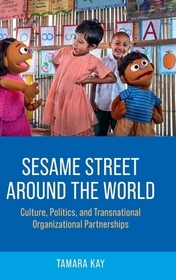
Sesame Street Around the World
Culture, Politics, and Transnational Organizational Partnerships
Series: Oxford Studies in Culture and Politics;
- Publisher's listprice GBP 81.00
-
36 571 Ft (34 830 Ft + 5% VAT)
The price is estimated because at the time of ordering we do not know what conversion rates will apply to HUF / product currency when the book arrives. In case HUF is weaker, the price increases slightly, in case HUF is stronger, the price goes lower slightly.
- Discount 10% (cc. 3 657 Ft off)
- Discounted price 32 914 Ft (31 347 Ft + 5% VAT)
Subcribe now and take benefit of a favourable price.
Subscribe
36 571 Ft

Availability
printed on demand
Why don't you give exact delivery time?
Delivery time is estimated on our previous experiences. We give estimations only, because we order from outside Hungary, and the delivery time mainly depends on how quickly the publisher supplies the book. Faster or slower deliveries both happen, but we do our best to supply as quickly as possible.
Product details:
- Publisher OUP USA
- Date of Publication 19 January 2026
- ISBN 9780190844295
- Binding Hardback
- No. of pages240 pages
- Size 234x156x17 mm
- Weight 517 g
- Language English 672
Categories
Short description:
This book explores how Sesame Workshop and its international partners coproduce local Sesame Street programs around the world.
MoreLong description:
Given the sometimes extraordinary politicization of culture, it is surprising that Sesame Street has gained acceptance and legitimacy in more than fifty countries. Sesame Street's global success raises two questions. First, how does a US icon like Sesame Street spread around the world, gaining acceptance as a local cultural product? Second, how does the nonprofit that created it, Sesame Workshop, and its partners around the world navigate cultural differences, manage conflicts, and construct shared collective representations to create Sesame Street programs that resonate with local audiences?
Tamara Kay answers these questions using data from seven years of intensive ethnographic fieldwork and 200 in-depth interviews with Sesame Workshop staff and international partners-including their real-time interactions-from seventeen countries within four regions around the world. Kay argues that Sesame Workshop's secret is its engagement in coproduction, meaning it works with partners as a transnational team to create local Sesame Street programs together. Through coproduction, Sesame Workshop and its partners create new collective identities by constructing value to align their interests and exchanging complex cultural knowledge to both customize and build alliances. She traces the successive processes of coproduction, beginning with the imagination of the cultural product, to its disassembly, reconstitution, and dissemination. Coproduction privileges the creation of new knowledge that emerges from transnational interaction, and uses that new knowledge to create a hybrid cultural product. The Sesame Street case grapples with and illuminates culture in transnational interaction, providing insight into a range of other transnational organizational partnerships and different kinds of hybrid cultural products.
Table of Contents:
Introduction: Coproduction and Sesame Street: Culture in Transnational Interaction
Universality and Particularity: Variation and the Sesame Model
Disassembling Sesame Street: Constructing Value to Align Interests
Reconstituting Sesame Street: Exchanging Cultural Knowledge to Customize
Pushing Cultural Boundaries: Authenticity and Social Change
Disseminating Sesame Street: Exchanging Cultural Knowledge to Build Alliances
Managing and Resolving Conflicts
Conclusions
Epilogue: The Sesame Model, Sustainability and Scale
Appendix I: Data and Methods

