

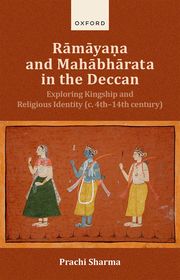
Rāmāyaṇa and Mahābhārata in the Western Deccan
Exploring Kingship and Religious Identity (c.4th–14th century)
- Publisher's listprice GBP 99.00
-
44 698 Ft (42 570 Ft + 5% VAT)
The price is estimated because at the time of ordering we do not know what conversion rates will apply to HUF / product currency when the book arrives. In case HUF is weaker, the price increases slightly, in case HUF is stronger, the price goes lower slightly.
- Discount 10% (cc. 4 470 Ft off)
- Discounted price 40 229 Ft (38 313 Ft + 5% VAT)
Subcribe now and take benefit of a favourable price.
Subscribe
44 698 Ft

Availability
Not yet published.
Why don't you give exact delivery time?
Delivery time is estimated on our previous experiences. We give estimations only, because we order from outside Hungary, and the delivery time mainly depends on how quickly the publisher supplies the book. Faster or slower deliveries both happen, but we do our best to supply as quickly as possible.
Product details:
- Publisher OUP Oxford
- Date of Publication 29 May 2026
- ISBN 9780198939122
- Binding Hardback
- No. of pages352 pages
- Size 216x140 mm
- Language English 700
Categories
Short description:
Covering the 4th–14th centuries, this book shows how Deccan rulers used the Rāmāyaṇa and Mahabharata in politics and public culture. Through epigraphic evidence, it traces shifting uses of epic heroes—from royal models to temple deities—and how diverse communities engaged these traditions.
MoreLong description:
Spanning a millennium from the 4th to the 14th century, this book explores the dynamic role of the Rāmāyaṇa and the Mahābhārata in shaping the political and socio-cultural landscape of the Deccan. Drawing on a wealth of epigraphic evidence, especially royal praśastis (eulogies), it reveals how ruling dynasties like the Kadambas and Hoysaḷas strategically appropriated epic motifs, heroes, and narratives to craft ideologies of kingship and divine legitimacy. Far from being confined to the religious sphere, the epics were actively woven into the public and political discourse, influencing not just elites but various social groups across the region. This study probes how different communities engaged with these traditions, beyond worship, to express identity, authority, and aspiration. Notably, it traces a significant shift around the 10th century, when epic heroes such as Rāma and Hanumān transitioned from royal exemplars to temple deities, marking an evolution in their cultural and symbolic significance. This work offers a compelling insight into the enduring power of epic traditions in South Indian history.
More
