

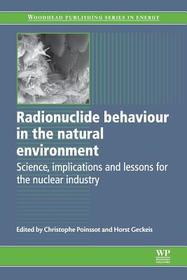
Radionuclide Behaviour in the Natural Environment
Science, Implications and Lessons for the Nuclear industry
Series: Woodhead Publishing Series in Energy;
- Publisher's listprice EUR 230.00
-
95 392 Ft (90 850 Ft + 5% VAT)
The price is estimated because at the time of ordering we do not know what conversion rates will apply to HUF / product currency when the book arrives. In case HUF is weaker, the price increases slightly, in case HUF is stronger, the price goes lower slightly.
- Discount 10% (cc. 9 539 Ft off)
- Discounted price 85 853 Ft (81 765 Ft + 5% VAT)
Subcribe now and take benefit of a favourable price.
Subscribe
95 392 Ft

Availability
cancelled
Why don't you give exact delivery time?
Delivery time is estimated on our previous experiences. We give estimations only, because we order from outside Hungary, and the delivery time mainly depends on how quickly the publisher supplies the book. Faster or slower deliveries both happen, but we do our best to supply as quickly as possible.
Product details:
- Publisher Elsevier Science
- Date of Publication 30 October 2018
- ISBN 9780081016206
- Binding Paperback
- No. of pages744 pages
- Size 233x155 mm
- Language English 0
Categories
Long description:
Understanding radionuclide behaviour in the natural environment is essential to the sustainable development of the nuclear industry and key to assessing potential environmental risks reliably. Minimising those risks is essential to enhancing public confidence in nuclear technology. Scientific knowledge in this field has developed greatly over the last decade.Radionuclide behaviour in the natural environment provides a comprehensive overview of the key processes and parameters affecting radionuclide mobility and migration.
After an introductory chapter, part one explores radionuclide chemistry in the natural environment, including aquatic chemistry and the impact of natural organic matter and microorganisms. Part two discusses the migration and radioecological behavior of radionuclides. Topics include hydrogeology, sorption and colloidal reactions as well as in-situ investigations. Principles of modelling coupled geochemical, transport and radioecological properties are also discussed. Part three covers application issues: assessment of radionuclide behaviour in contaminated sites, taking Chernobyl as an example, estimation of radiological exposure to the population, performance assessment considerations related to deep geological repositories, and remediation concepts for contaminated sites.
With its distinguished editors and international team of expert contributors, Radionuclide behaviour in the natural environment is an essential tool for all those interested or involved in nuclear energy, from researchers, designers and industrial operators to environmental scientists. It also provides a comprehensive guide for academics of all levels in this field.
Table of Contents:
"
Contributor contact details
Woodhead Publishing Series in Energy
Foreword
Chapter 1: Overview of radionuclide behaviour in the natural environment
Abstract:
1.1 Introduction
1.2 Radionuclides of interest
1.3 Environmental compartments to be considered
1.4 References
Part I: Radionuclide chemistry in the natural environment
Chapter 2: Fundamentals of aquatic chemistry relevant to radionuclide behaviour in the environment
Abstract:
2.1 Introduction
2.2 Composition of natural waters
2.3 Dissolution and precipitation
2.4 Aqueous complexes
2.5 Surface sorption
2.6 Colloids
2.7 Redox reactions
2.8 References
Chapter 3: Aquatic chemistry of the actinides: aspects relevant to their environmental behavior
Abstract:
3.1 Introduction
3.2 Oxidation states of actinides in aqueous solution
3.3 Actinide solid phases and solubility phenomena
3.4 Actinide complexation reactions
3.5 Chemical modeling tools and thermodynamic databases
3.6 Recommended literature
3.7 References
Chapter 4: Aquatic chemistry of long-lived mobile fission and activation products in the context of deep geological disposal
Abstract:
4.1 Introduction
4.2 The effects of the near field in high-level radioactive waste disposal
4.3 Solution and interfacial chemistry of selected radionuclides
4.4 Summary
4.5 References
Chapter 5: Impacts of humic substances on the geochemical behaviour of radionuclides
Abstract:
5.1 Introduction to humic substances
5.2 The 'humic acid molecule'
5.3 Discrete models of metal ion-humic interactions
5.4 Multiligand and macromolecular models of metal ion-humic interactions
5.5 Kinetic models of metal ion-humic interactions
5.6 Impacts of humic substances on radionuclide transport in different sites worldwide
5.7 Conclusions and future trends
5.8 References
Chapter 6: Impacts of microorganisms on radionuclides in contaminated environments and waste materials
Abstract:
6.1 Introduction
6.2 Biotransformation of uranium
6.3 Biotransformation of plutonium
6.4 Biosorption and bioaccumulation of uranium and plutonium
6.5 Biotransformation of other actinides and related elements
6.6 Biotransformation of fission and activation products
6.7 Microbiological studies of low- and intermediate-level wastes, and high-level waste repository sites
6.8 Conclusion
6.9 Acknowledgments
6.11 References
Part II: Radionuclide migration
Chapter 7: Hydrogeological features relevant to radionuclide migration in the natural environment
Abstract:
7.1 Introduction
7.2 The water content of the subsoil
7.3 Groundwater movement in the soil and subsoil
7.4 Aquifer systems
7.5 Groundwater flow equations for aquifer systems
7.6 Solving the flow equations for aquifer systems
7.7 References
Chapter 8: Radionuclide retention at mineralï¿1⁄2?""water interfaces in the natural environment
Abstract:
8.1 Introduction
8.2 Macroscopic studies of radionuclide sorption
8.3 Sorption models
8.4 Spectroscopic techniques
8.5 Future developments
8.6 Acknowledgements
8.7 References
Chapter 9: Radionuclide migration: coupling transport and chemistry
Abstract:
9.1 Introduction
9.2 The transport phenomenon
9.3 Coupling chemistry to transport
9.4 Application examples
9.5 References
Chapter 10: Impact of colloidal transport on radionuclide migration in the natural environment
Abstract:
10.1 Introduction
10.2 Geochemistry and sorption behavior of radionuclides
10.3 Nature and origin of colloids
10.4 Colloid characteristics
10.5 Laboratory experiments of colloid-facilitated radionuclide transport
10.6 Field studies of radionuclide migration
10.7 Conclusion and future trends
10.8 Acknowledgments
10.9 References
Chapter 11: Natural analogues of nuclear waste repositories: studies and their implications for the development of radionuclide migration models
Abstract:
11.1 Introduction
11.2 Nature and limitations of natural analogues
11.3 Selected natural analogue sites
11.4 Lessons on radionuclide (RN) geochemistry and migration from main natural analogues studies
11.5 Conclusion
11.6 Acknowledgement
11.7 References
Chapter 12: Studying radionuclide migration on different scales: the complementary roles of laboratory and in situ experiments
Abstract:
12.1 Introduction
12.2 Designing laboratory studies at different scales on radionuclide diffusion in underground environments
12.3 Studies at different scales on diffusion in Swiss Opalinus Clay
12.4 Studies at different scales on diffusion in French Callovo-Oxfordian claystone
12.5 Laboratory experiments at the decimetre-scale on the transport of radionuclides in non-consolidated porous media
12.6 Conclusions and future trends
12.7 References
12.8 Appendix: definitions and abbreviations
Chapter 13: Radionuclide transfer processes in the biosphere
Abstract:
13.1 Introduction
13.2 Radionuclide speciation and interactions with biological ligands
13.3 Transfer to plants and biodistribution
13.4 Transfer to animal species and biodistribution
13.5 Transfer to man
13.6 Effect on metabolic pathways
13.7 Transfers through epithelial barriers: the digestive barrier
13.8 Membrane transport
13.9 Intracellular mechanisms: homeostasis and stress
13.10 Future trends
13.11 Acknowledgements
13.12 References
Part III: Environmental impact and remediation
Chapter 14: Modelling radionuclide transport in the environment and calculating radiation doses
Abstract:
14.1 Introduction
14.2 Modelling radionuclide transport in the environment
14.3 Assessing radiation doses to humans
14.4 Assessing radiation doses to non-human biota
14.5 Achieving a comprehensive assessment
14.6 Conclusion and future trends
14.7 References
Chapter 15: Quantitative assessment of radionuclide migration from near-surface radioactive waste burial sites: the waste dumps in the Chernobyl exclusion zone as an example
Abstract:
15.1 Introduction
15.2 The Chernobyl Pilot Site in the Red Forest
15.3 Modelling radionuclide migration in the aquifer considering stationary hydrodynamic and geochemical conditions
15.4 Prediction of 90Sr migration, assuming non-stationary hydro-biogeochemical conditions
15.5 Conclusions and future trends
15.6 Acknowledgements
15.7 References
Chapter 16: Remediation of sites contaminated by radionuclides
Abstract:
16.1 Introduction
16.2 Potential sources of radionuclide release
16.3 Methods of cleaning contaminated sites
16.4 Environmental monitoring tools
16.5 Modelling tools for planning clean-up
16.6 Risk assessment studies of hazardous sites and clean-up measures
16.7 Examples of remediation of contaminated sites
16.8 Sources of further information
16.9 References
Chapter 17: Safety assessment of nuclear waste repositories: a radionuclide migration perspective
Abstract:
17.1 Introduction
17.2 Repository concepts
17.3 Safety assessment (SA) methodology
17.4 Integration of the main radionuclide migration processes and parameters in the safety assessment (SA) models
17.5 Gaps in understanding and the qualification and quantification of the safety assessment (SA) models
17.6 Conclusions
17.7 Acknowledgements
17.8 References
Index
" More
