

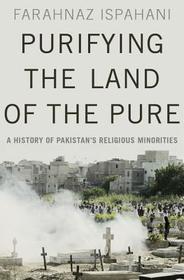
Purifying the Land of the Pure
A History of Pakistan's Religious Minorities
- Publisher's listprice GBP 31.99
-
15 283 Ft (14 555 Ft + 5% VAT)
The price is estimated because at the time of ordering we do not know what conversion rates will apply to HUF / product currency when the book arrives. In case HUF is weaker, the price increases slightly, in case HUF is stronger, the price goes lower slightly.
- Discount 10% (cc. 1 528 Ft off)
- Discounted price 13 754 Ft (13 100 Ft + 5% VAT)
Subcribe now and take benefit of a favourable price.
Subscribe
15 283 Ft

Availability
printed on demand
Why don't you give exact delivery time?
Delivery time is estimated on our previous experiences. We give estimations only, because we order from outside Hungary, and the delivery time mainly depends on how quickly the publisher supplies the book. Faster or slower deliveries both happen, but we do our best to supply as quickly as possible.
Product details:
- Publisher OUP USA
- Date of Publication 9 March 2017
- ISBN 9780190621650
- Binding Hardback
- No. of pages224 pages
- Size 239x157x25 mm
- Weight 440 g
- Language English 0
Categories
Short description:
In Purifying the Land of the Pure, Farahnaz Ispahani analyzes Pakistan's policies towards its religious minority populations, both Muslim and non-Muslim, since independence in 1947.
MoreLong description:
When Pakistan was founded in 1947, it had a rich tapestry of different religious groups, ranging from Sunni and Shiite Muslims to Christians, Parsis, Hindus, and Jainists. Non-Muslims comprised 23 percent of the total population, and non-Sunnis comprised a quarter of the Muslim population. Mohammed Ali Jinnah, Pakistan's first president, proclaimed that the nation had a place for all of its citizens, regardless of religion. Today, non-Muslims comprise a mere 3 percent of the population, and in recent years all non-Sunnis have been subjected to increasing levels of persecution and violence. What happened?
In Purifying the Land of the Pure, Farahnaz Ispahani analyzes Pakistan's policies towards its religious minority populations, both Muslim and non-Muslim, since independence in 1947. Originally created as a homeland for South Asia's Muslims, Pakistan was designed to protect the subcontinent's largest religious minority. But soon after independence, religious as well as some political leaders declared that the objective of Pakistan's creation was more specific and narrow: to create an Islamic State. In 1949, Pakistan's Constituent Assembly ratified this objective, and that in turn established the path that Pakistan would follow. The event that accelerated the pace towards intolerance of non-Sunnis, however, was the assumption of power by President Zia Ul Haq over a quarter century later, in 1977. His regime promoted a stricter version of Sunni Islam at the expense of other denominations, and by the end of his reign the Pakistani state was no longer a welcome place for minorities. Many people from religious minorities fled, but those who remained faced escalating persecution, both from state and non-state actors which enjoyed the tacit support of the regime. The years since 9/11 have been punctuated by recurrent pogroms against religious minorities, and thousands have died. Shiites have suffered the most assaults from Sunni extremists, but virtually every minority has been attacked repeatedly. Ispahani traces this history, and stresses how the contradictions at the heart of the Pakistani state-building project have fueled the intolerance. Originally created as a homeland for the subcontinent's Muslims, Pakistan was still religiously very diverse. Over time, efforts to 'correct' this problem radicalized significant segments of the Sunni population, setting in motion a self-reinforcing process of escalating persecution. Some elements of the ruling class exploited these prejudices in opportunistic fashion, while others were zealots themselves. In the end, what drove these elements did not matter much, as the result was the same: a state that ignored frequent attacks on religious minorities by increasingly radicalized Sunni groups bent on 'purifying' the nation. Concise yet sweeping in its coverage, Purifying the Land of the Pure will be essential reading for anyone interested in why this pivotal geopolitical player is so plagued by radicalism and violence.
Concise yet sweeping in its coverage
Table of Contents:
Introduction
Chapter One: Demography, State and Religion
Chapter Two: Ideological State
Chapter Three: Militarism and National Identity
Chapter Four: Balancing Act: 1972-77
Chapter Five: Islamization: 1977-88
Chapter Six: Global Jihad and Pakistan's Minorities, 1988-99
Chapter Seven: Militancy, Terrorism and Sectarianism, 1999-onwards

