

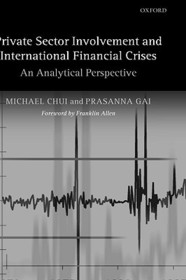
Private Sector Involvement and International Financial Crises
An Analytical Perspective
- Publisher's listprice GBP 117.50
-
53 051 Ft (50 525 Ft + 5% VAT)
The price is estimated because at the time of ordering we do not know what conversion rates will apply to HUF / product currency when the book arrives. In case HUF is weaker, the price increases slightly, in case HUF is stronger, the price goes lower slightly.
- Discount 10% (cc. 5 305 Ft off)
- Discounted price 47 746 Ft (45 473 Ft + 5% VAT)
Subcribe now and take benefit of a favourable price.
Subscribe
53 051 Ft

Availability
printed on demand
Why don't you give exact delivery time?
Delivery time is estimated on our previous experiences. We give estimations only, because we order from outside Hungary, and the delivery time mainly depends on how quickly the publisher supplies the book. Faster or slower deliveries both happen, but we do our best to supply as quickly as possible.
Product details:
- Publisher OUP Oxford
- Date of Publication 27 January 2005
- ISBN 9780199267750
- Binding Hardback
- No. of pages224 pages
- Size 242x163x17 mm
- Weight 485 g
- Language English
- Illustrations numerous line figures 0
Categories
Short description:
This is the first book to integrate analyses of sovereign debt and crises in financial markets. Offering an analytical perspective on the design of the international financial architecture, this book relates insights from recent literature on co-ordination games to earlier work on currency crises and sovereign debt default to set out a coherent framework for the assessment of crisis management policy. Issues examined include the design of sovereign bankruptcy procedures, and the role of the IMF in influencing creditors and debtor countries.
MoreLong description:
Offering an analytical perspective on the design and reform of the international financial architecture, this book stresses the important role played by creditor co-ordination problems in the origin and management of crises by relating the insights of the new literature on global games to earlier work on currency crises, bank runs, and sovereign debt default. It examines the design of sovereign bankruptcy procedures, the role of the IMF in influencing creditors and debtor countries, and the currency composition of sovereign debt, and draws on recent research and policy work.
The book's first part provides a critical synthesis of the literature underpinning the architecture debate. It reviews the traditional distinction between "fundamentals-based" and "sunspot-based" crises before reconciling the two using global game methods. The role of co-ordination problems in sparking costly liquidation and influencing the debtor's incentives to repay is then examined in depth and shown to lie at the heart of crisis management policy. The empirical literature on leading indicators of crisis is also critically examined and related to the architecture debate.
In its second part the book examines key issues in crisis management. Suggesting that optimal reforms must set the inefficiencies of crisis against the inefficiencies of debtor moral hazard, the authors consider the relative merits of statutory and contractual solutions to sovereign debt workouts. They go on to discuss the role of the IMF in influencing private lending and debtor moral hazard, theoretically and empirically. They argue that there is no simple relationship between ex post crisis management and ex ante moral hazard, implying that the handling of financial crises is a delicate affair warranting a cautious approach by would-be architects.
...the authors do an excellent job. The book will appeal to anyone interested in the serious study of financial crises and the design of international financial mechanisms.
Table of Contents:
Introduction
Part I: The Analytics of Crisis
Overview: causes, costs, and prediction
Sunspot-based models
Fundamentals-based models
Reconciling the two views
Crisis costs and incentives to repay
Spotting financial crises
Part II: Reforming the International Financial Architecture
Overview: dealing with crises
Sovereign debt workouts
Open issues
The 'original sin' problem
Next steps in the debate
Appendix A: First-order differential equation
Appendix B: Conditional distributions
Index

