

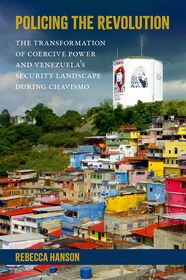
Policing the Revolution
The Transformation of Coercive Power and Venezuela's Security Landscape During Chavismo
Series: Global and Comparative Ethnography;
- Publisher's listprice GBP 19.99
-
9 550 Ft (9 095 Ft + 5% VAT)
The price is estimated because at the time of ordering we do not know what conversion rates will apply to HUF / product currency when the book arrives. In case HUF is weaker, the price increases slightly, in case HUF is stronger, the price goes lower slightly.
- Discount 10% (cc. 955 Ft off)
- Discounted price 8 595 Ft (8 186 Ft + 5% VAT)
Subcribe now and take benefit of a favourable price.
Subscribe
9 550 Ft

Availability
Estimated delivery time: In stock at the publisher, but not at Prospero's office. Delivery time approx. 3-5 weeks.
Not in stock at Prospero.
Why don't you give exact delivery time?
Delivery time is estimated on our previous experiences. We give estimations only, because we order from outside Hungary, and the delivery time mainly depends on how quickly the publisher supplies the book. Faster or slower deliveries both happen, but we do our best to supply as quickly as possible.
Product details:
- Publisher OUP USA
- Date of Publication 23 May 2025
- ISBN 9780197680827
- Binding Paperback
- No. of pages280 pages
- Size 234x159x19 mm
- Weight 358 g
- Language English 639
Categories
Short description:
In Policing the Revolution, Rebecca Hanson provides the first in-depth analysis of policing and security policies during the Bolivarian Revolution in Venezuela, focusing on the experiences of three groups: police officers, police reformers, and residents of neighborhoods most affected by violence. Drawing on ethnographic, interview, and survey research collected over ten years, she analyzes how security policies within the context of the pink tide and later turn to authoritarianism contributed to the expansion of lateral violence and the pluralization of non-state violent actors. Rethinking the relationship between revolution, violence, and state-building, this book is essential reading to understand how and why violence increased so dramatically in Venezuela in the twenty-first century.
MoreLong description:
Since the mid-2000s Venezuela has been ranked one of the most violent countries in the world as homicides and police violence skyrocketed. Much has been written about the country's turn to Chavismo but scholarship has ignored what will perhaps be the revolution's most important legacy: how Chavista policies transformed coercive power and the security landscape.
In Policing the Revolution, Rebecca Hanson provides the first in-depth analysis of policing and security policies during the Bolivarian Revolution in Venezuela, focusing on the experiences of three groups: police officers, police reformers, and residents of neighborhoods most affected by violence. Drawing on ethnographic, interview, and survey research collected over ten years, she analyzes how security policies within the context of the pink tide and later turn to authoritarianism contributed to the expansion of lateral violence and the pluralization of non-state armed actors. Far from the always-already authoritarian project proposed by many scholars and pundits, Hanson shows that the Bolivarian Revolution was defined by highly contested and contrasting visions of security that resulted in a fragmented and inconsistent ordering of state and society. Moreover, by pairing the vantage point of street-level police officers with that of ordinary barrio residents, she provides a unique analysis of how insecurity during revolution was experienced "from below."
Rethinking the relationship between revolution, violence, and state-building, this book is essential reading to understand how and why violence increased so dramatically in Venezuela in the twenty-first century.
Hanson's Policing the Revolution provides counterintuitive insights into the nature of politics and the state in Bolivarian Venezuela. The book addresses important and complex puzzles that fit Venezuela into debates about violence in Latin America, highlighting similarities but also key differences. Hanson perceptively shows that violence and crime in Venezuela emerge, in part, because of decisions made by state leaders that keep the police disorganized, thus reducing their capacity to engage in effective law enforcement and shifting the balance of police power in the country. Hanson's detailed and incisive ethnography of Venezuelan police provides critical insights into politics in that country and its police forces.
Table of Contents:
List of Illustrations
Chapter 1: Introduction
Chapter 2: Research Design, Methods, and Embodied Ethnography
Chapter 3: Reform and its Discontents
Chapter 4: Securing the Revolution Part I
Chapter 5: Malandros Uniformados: Masculinity, Marginalization, Insecurity, and Attitudes on Police Violence
Chapter 6: The New Socialist Mother and Her Fight against Crime
Chapter 7: Caiga quien Cagia: Systematic Killing in Maduro's Venezuela
Chapter 8: Securing the Revolution Part II
Chapter 9: Conclusion
Index

