

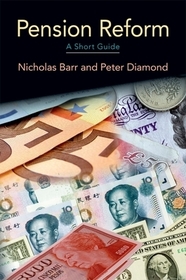
Pension Reform
A Short Guide
- Publisher's listprice GBP 43.49
-
19 635 Ft (18 700 Ft + 5% VAT)
The price is estimated because at the time of ordering we do not know what conversion rates will apply to HUF / product currency when the book arrives. In case HUF is weaker, the price increases slightly, in case HUF is stronger, the price goes lower slightly.
- Discount 10% (cc. 1 964 Ft off)
- Discounted price 17 672 Ft (16 830 Ft + 5% VAT)
Subcribe now and take benefit of a favourable price.
Subscribe
19 635 Ft

Availability
printed on demand
Why don't you give exact delivery time?
Delivery time is estimated on our previous experiences. We give estimations only, because we order from outside Hungary, and the delivery time mainly depends on how quickly the publisher supplies the book. Faster or slower deliveries both happen, but we do our best to supply as quickly as possible.
Product details:
- Publisher OUP USA
- Date of Publication 10 December 2009
- ISBN 9780195387728
- Binding Paperback
- No. of pages264 pages
- Size 231x152x17 mm
- Weight 454 g
- Language English
- Illustrations 12 black and white line illustrations 0
Categories
Short description:
This is an abridgement of Barr and Diamond's 'Reforming Pensions: Principles and Policy Choices' (OUP, 2008), a larger book that is intended for policy makers and as a supplement in college courses.
MoreLong description:
This is an abridgement of Barr and Diamond's 'Reforming Pensions: Principles and Policy Choices' (OUP, 2008), a larger book that is intended for policy makers and as a supplement in college courses.
The problem. Mandatory pension systems are a worldwide phenomenon. However, with given contribution rates, monthly benefits and retirement ages, pension systems are not consistent with three long-run trends - declining mortality, declining fertility, and earlier retirement. Thus many systems need reform.
Principles. This book gives an extensive but nontechnical explanation of the economics of pension design. The theoretical arguments have three elements.
1. Pension systems have multiple objectives - consumption smoothing, insurance, poverty relief, and redistribution. Good policy needs to bear them all in mind.
2. Good analysis should be framed in a second-best context - simple economic models are a bad guide to policy design in a world with imperfect information and decision-making, incomplete markets and taxation.
3. Any choice of pension system has distributional consequences, which the book recognizes explicitly.
The analysis includes discussion of labor markets, capital markets, risk sharing and gender and family, with comparison of PAYG and funded systems, recognizing that the suitable level of funding differs by country.
Alongside the economic principles of good design, policy must also take account of a country's capacity to implement the system. Thus the theoretical analysis is complemented by discussion of implementation, and of experiences, both good and bad, in many countries, with particular attention to China and Chile.
Policy conclusions:
1. Sound application of the principles outlined above can and does lead to widely different systems in different country settings.
2. Unless there are transfers from outside the system, any improvement to the finances of a pension system must involve one or more of (a) higher contribution rates, (b) lower monthly pensions, (c) later retirement at the same monthly pension, (d) policies designed to increase national output.
3.The previous statement holds whatever the degree of funding. If a public pension is regarded as unsustainable the problem needs to be addressed directly by one of these methods.
The book is a must-read for any student who wants to work in public administrationsince pensions affect virtually every sector of public policy, and increasingly so in developing countriesand not only for pension experts. It is extremely well written and clear, and it is an intellectual joy to separate the two voices in this masterpiece of economic music: the first and fundamental voice of scientific deduction, almost always intertwined with the second, lower key voice of a legitimate but not uncontroversial paternalistic view of a largely benevolent government.
Table of Contents:
Foreword to Principles and policy choices by Professor Lord Stern
Preface
The backdrop
The basic economics of pensions
Pensions and labor markets
Finance and funding
Redistribution and risk sharing
Gender and family
Implementing pensions
International diversity and change since 1950
Pension systems in different countries
Close focus: Pension reform in Chile and China
Principles and lessons for policy
Glossary
References
Index

