

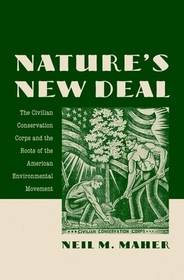
Nature's New Deal
The Civilian Conservation Corps and the Roots of the American Environmental Movement
- Publisher's listprice GBP 26.99
-
12 185 Ft (11 605 Ft + 5% VAT)
The price is estimated because at the time of ordering we do not know what conversion rates will apply to HUF / product currency when the book arrives. In case HUF is weaker, the price increases slightly, in case HUF is stronger, the price goes lower slightly.
- Discount 10% (cc. 1 218 Ft off)
- Discounted price 10 967 Ft (10 445 Ft + 5% VAT)
Subcribe now and take benefit of a favourable price.
Subscribe
12 185 Ft

Availability
printed on demand
Why don't you give exact delivery time?
Delivery time is estimated on our previous experiences. We give estimations only, because we order from outside Hungary, and the delivery time mainly depends on how quickly the publisher supplies the book. Faster or slower deliveries both happen, but we do our best to supply as quickly as possible.
Product details:
- Publisher OUP USA
- Date of Publication 7 October 2010
- ISBN 9780195392418
- Binding Paperback
- No. of pages328 pages
- Size 231x155x22 mm
- Weight 476 g
- Language English
- Illustrations 20 halftones 0
Categories
Short description:
In Nature's New Deal, Neil M. Maher examines the history of one of Franklin D. Roosevelt's boldest and most successful experiments, the Civilian Conservation Corps, describing it as a turning point both in national politics and in the emergence of modern environmentalism.
MoreLong description:
The Great Depression coincided with a wave of natural disasters, including the Dust Bowl and devastating floods of the Ohio and Mississippi rivers. Recovering from these calamities--and preventing their reoccurrence--was a major goal of the New Deal.
In Nature's New Deal, Neil M. Maher examines the history of one of Franklin D. Roosevelt's boldest and most successful experiments, the Civilian Conservation Corps, describing it as a turning point both in national politics and in the emergence of modern environmentalism. Indeed, Roosevelt addressed both the economic and environmental crises by putting Americans to work at conserving natural resources, through the Soil Conservation Service, the Tennessee Valley Authority, and the Civilian Conservation Corps (or CCC). The CCC created public landscapes--natural terrain altered by federal work projects--that helped environmentalism blossom after World War II, Maher notes. Millions of Americans devoted themselves to a new vision of conservation, one that went beyond the old model of simply maximizing the efficient use of natural resources, to include the promotion of human health through outdoor recreation, wilderness preservation, and ecological balance. And yet, as Maher explores the rise and development of the CCC, he also shows how the critique of its campgrounds, picnic areas, hiking trails, and motor roads frames the debate over environmentalism to this day.
From the colorful life at CCC camps, to political discussions in the White House and the philosophical debates dating back to John Muir and Frederick Law Olmsted, Nature's New Deal captures a key moment in the emergence of modern environmentalism.
Maher has satisfied long unsatiated appetites with a full plate of new ideas and insight about Franklin Roosevelt's beloved agency and should be congratulated for bringing science into the historical equation.
Table of Contents:
Introduction: New Deal Conservation
Ideas: Franklin Roosevelt's Progressive Era Influences
Landscapes: The Evolution of CCC Conservation
Labor: Enrollee Work and the Body Politics
Community: Locals and Next Door Natures
Nation: The Great Conservation Debate
Planning: From Top-Down Conservation to Bottom-Up Environment
Epilogue: New Deal Landscapes in the Environmental Era

