

- Publisher's listprice GBP 22.49
-
10 154 Ft (9 670 Ft + 5% VAT)
The price is estimated because at the time of ordering we do not know what conversion rates will apply to HUF / product currency when the book arrives. In case HUF is weaker, the price increases slightly, in case HUF is stronger, the price goes lower slightly.
- Discount 10% (cc. 1 015 Ft off)
- Discounted price 9 138 Ft (8 703 Ft + 5% VAT)
Subcribe now and take benefit of a favourable price.
Subscribe
10 154 Ft

Availability
Estimated delivery time: In stock at the publisher, but not at Prospero's office. Delivery time approx. 3-5 weeks.
Not in stock at Prospero.
Why don't you give exact delivery time?
Delivery time is estimated on our previous experiences. We give estimations only, because we order from outside Hungary, and the delivery time mainly depends on how quickly the publisher supplies the book. Faster or slower deliveries both happen, but we do our best to supply as quickly as possible.
Product details:
- Publisher OUP USA
- Date of Publication 12 August 2019
- ISBN 9780190916435
- Binding Paperback
- No. of pages264 pages
- Size 160x234x20 mm
- Weight 363 g
- Language English 0
Categories
Short description:
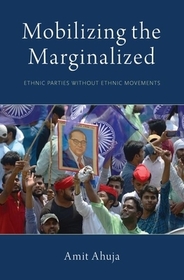
In Mobilizing the Marginalized, Amit Ahuja shows how social movements by marginalized ethnic groups - those who are stigmatized by others and disproportionately poor - undermine bloc voting to generate competition for marginalized citizens' votes across political parties.
MoreLong description:
India's over 200 million Dalits, once called "untouchables," have been mobilized by social movements and political parties, but the outcomes of this mobilization are puzzling. Dalits' ethnic parties have performed poorly in elections in states where movements demanding social equality have been strong while they have succeeded in states where such movements have been entirely absent or weak. In Mobilizing the Marginalized, Amit Ahuja demonstrates that the collective action of marginalized groups--those that are historically stigmatized and disproportionately poor --- is distinct. Drawing on extensive original research conducted across four of India's largest states, he shows, for the marginalized, social mobilization undermines the bloc voting their ethnic parties' rely on for electoral triumph and increases multi-ethnic political parties' competition for marginalized votes. He presents evidence showing that a marginalized group gains more from participating in a social movement and dividing support among parties than from voting as a bloc for an ethnic party.
Armed with substantial research and possessing intellectual energy to challenge conventional wisdom, Amit Ahuja provides a convincing counterpoint to fallacious understandings of the layered relationship between self-assertion movements and ethnic electoral mobilization.
Table of Contents:
List of Figures, Maps, and TablesPreface
Acknowledgments
List of Abbreviations
1 Introduction
2 Mobilizing the Marginalized
3 Historical Dalit Social Mobilization
4 The Effects of Historical Dalit Social Mobilization
5 Dalit Party Performance and Bloc Voting
6 Dalit Social Mobilization and Bloc Voting
7 How Mobilization Type Shapes Dalit Welfare
8 The Identity Trap
9 Conclusion: Whither Dalit Politics?
Appendix A Focus Groups and Follow-up Interviews
Appendix B Locality-based Campaign Survey
Appendix C An Observational Study Assessing Caste Boundaries in the Indian
Marriage Market
Glossary

