

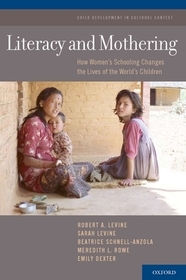
Literacy and Mothering
How Women's Schooling Changes the Lives of the World's Children
Series: Child Development in Cultural Context Series;
- Publisher's listprice GBP 82.00
-
37 023 Ft (35 260 Ft + 5% VAT)
The price is estimated because at the time of ordering we do not know what conversion rates will apply to HUF / product currency when the book arrives. In case HUF is weaker, the price increases slightly, in case HUF is stronger, the price goes lower slightly.
- Discount 15% (cc. 0 Ft off)
- Discounted price 31 470 Ft (29 971 Ft + 5% VAT)
- Discount is valid until: 5 August 2026
Subcribe now and take benefit of a favourable price.
Subscribe
37 023 Ft

Availability
printed on demand
Why don't you give exact delivery time?
Delivery time is estimated on our previous experiences. We give estimations only, because we order from outside Hungary, and the delivery time mainly depends on how quickly the publisher supplies the book. Faster or slower deliveries both happen, but we do our best to supply as quickly as possible.
Product details:
- Publisher OUP USA
- Date of Publication 1 March 2012
- ISBN 9780195309829
- Binding Hardback
- No. of pages224 pages
- Size 163x236x22 mm
- Weight 499 g
- Language English
- Illustrations 5 B/W HT, 5 B/W Line 0
Categories
Short description:
Women's schooling is strongly related to child survival and other outcomes beneficial to children throughout the developing world, but the reasons behind this correlation have been unclear. In Literacy and Mothering, the authors show, for the first time, how communicative change plays a key role: Girls acquire academic literacy skills, even in low-quality schools, which enable them, as mothers, to understand public health messages in the mass media and to navigate bureaucratic health services effectively, reducing risks to their children's health. Assessments of these maternal skills in four diverse countries - Mexico, Nepal, Venezuela, and Zambia - support this model and are presented in the book.
MoreLong description:
Women's schooling is strongly related to child survival and other outcomes beneficial to children throughout the developing world, but the reasons behind these statistical connections have been unclear. In Literacy and Mothering, the authors show, for the first time, how communicative change plays a key role: Girls acquire academic literacy skills, even in low-quality schools, which enable them, as mothers, to understand public health messages in the mass media and to navigate bureaucratic health services effectively, reducing risks to their children's health. With the acquisition of academic literacy, their health literacy and health navigation skills are enhanced, thereby reducing risks to children and altering interactions between mother and child. Assessments of these maternal skills in four diverse countries - Mexico, Nepal, Venezuela, and Zambia - support this model and are presented in the book.
Chapter 1 provides a brief history of mass schooling, including the development of a bureaucratic Western form of schooling. Along with the bureaucratic organization of healthcare services and other institutions, this form of mass schooling spread across the globe, setting new standards for effective communication - standards that are, in effect, taught in school. Chapter 2 reviews the demographic and epidemiological evidence concerning the effects of mothers' education on survival, health, and fertility. In this chapter, the authors propose a model that shows how women's schooling, together with urbanization and changes in income and social status, reduce child mortality and improve health. In Chapter 3, the authors examine the concept of literacy and discuss how its meanings and measurements have been changed by educational research of the last few decades. Chapter 4 introduces the four-country study of maternal literacy. Chapters 5, 6, and 7 present the findings, focusing on academic literacy and its retention (Chapter 5), its impact on maternal health literacy and navigation skills (Chapter 6), and changes in mother-child interaction and child literacy skills (Chapter 7). Chapter 8 presents a new analysis of school experience, explores policy implications, and recommends further research.
My conclusion is unmitigated praise for the research and development of theory represented in Literacy and Mothering. It is a book that provides a solid foundation for answering important questions about how literacy is affecting the children of the world... It is densely packed with information and has much to offer anyone who cares about having a measurable impact on the future health of women and children.
Table of Contents:
Foreword
By Michael Cole
Part I. Theoretical Background: Historical and Sociological Perspectives
Chapter 1
The Rise and Spread of Western Schooling
Chapter 2
Women's Schooling and Social Change in the Developing World after 1950
Chapter 3
Re-Defining Literacy: A Theory of Bureaucratic Schooling
Part II. Maternal Literacy in Less Developed Countries
Chapter 4
Contexts of Mothers' Lives: The Four-Country Study
Chapter 5
Retention of Academic Literacy Skills
Chapter 6
Mothers as Pupils in Health Care Settings
Chapter 7
Mothers as Teachers at Home
Part III. Conclusions: The Processes of Global Change
Chapter 8
Communicative Processes: Schooling, Literacy and Maternal Behavior
Appendix A: Literacy Assessment Methods
Appendix B: Statistical Data

