

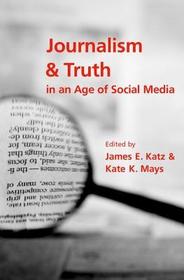
Journalism and Truth in an Age of Social Media
- Publisher's listprice GBP 102.50
-
48 969 Ft (46 637 Ft + 5% VAT)
The price is estimated because at the time of ordering we do not know what conversion rates will apply to HUF / product currency when the book arrives. In case HUF is weaker, the price increases slightly, in case HUF is stronger, the price goes lower slightly.
- Discount 10% (cc. 4 897 Ft off)
- Discounted price 44 072 Ft (41 973 Ft + 5% VAT)
Subcribe now and take benefit of a favourable price.
Subscribe
48 969 Ft

Availability
printed on demand
Why don't you give exact delivery time?
Delivery time is estimated on our previous experiences. We give estimations only, because we order from outside Hungary, and the delivery time mainly depends on how quickly the publisher supplies the book. Faster or slower deliveries both happen, but we do our best to supply as quickly as possible.
Product details:
- Publisher OUP USA
- Date of Publication 10 September 2019
- ISBN 9780190900250
- Binding Hardback
- No. of pages306 pages
- Size 160x239x20 mm
- Weight 570 g
- Language English 50
Categories
Short description:
This volume gathers leading scholars in the fields of journalism and communication studies, philosophy, and the social sciences to examine critical questions of how we should understand journalism's changing landscape as it relates to fundamental questions about the role of truth and information in society. Identifying and communicating truth is an age-old concern, greatly exacerbated and amplified by the onslaught of social media. Along with confronting the fake news phenomenon, chapter authors address the age-old issue of truth and credibility in journalism as it operates in politics, and how technology may be complicating that relationship. The book is designed as a supplemental text for journalism and related courses, a worthwhile read for scholars in the field, and an insightful guide for practicing journalists.
MoreLong description:
Truth qualities of journalism are under intense scrutiny in today's world. Journalistic scandals have eroded public confidence in mainstream media while pioneering news media compete to satisfy the public's appetite for news. Still worse is the specter of "fake news" that looms over media and political systems that underpin everything from social stability to global governance.
This volume aims to illuminate the contentious media landscape to help journalism students, scholars, and professionals understand contemporary conditions and arm them to deal with a spectrum of new developments ranging from technology and politics to best practices.
Fake news is among the greatest of these concerns, and can encompass everything from sarcastic or ironic humor to bot-generated, made-up stories. It can also include the pernicious transmission of selected, biased facts, the use of incomplete or misleadingly selective framing of stories, and photographs that editorially convey certain characteristics. This edited volume contextualizes the current "fake news problem." Yet it also offers a larger perspective on what seems to be uniquely modern, computer-driven problems. We must remember that we have lived with the problem of people having to identify, characterize, and communicate the truth about the world around them for millennia.
Rather than identify a single culprit for disseminating misinformation, this volume examines how news is perceived and identified, how news is presented to the public, and how the public responds to news. It considers social media's effect on the craft of journalism, as well as the growing role of algorithms, big data, and automatic content-production regimes. As an edited collection, this volume gathers leading scholars in the fields of journalism and communication studies, philosophy, and the social sciences to address critical questions of how we should understand journalism's changing landscape as it relates to fundamental questions about the role of truth and information in society.
Katz and Mays assembled a stellar group of experts on journalism from across the social and behavior sciences, the humanities, and technology fields to inquire about the construction, circulation, and reception of truth. This volume illuminates critical challenges and opportunities that contemporary media face, which will be of great interest to scholars, students, practitioners, and the general public
Table of Contents:
List of Contributors
Acknowledgements
Preface
Chapter 1. Introduction
James E. Katz and Kate K. Mays
Democracy, News, & Society
Chapter 2. Belgium Invades Germany: Can Facts Survive Politics?
Michael Schudson
Spotlight: Pierre Bourdieu and the Journalistic Field
David L. Swartz
Chapter 3. From information availability to factual accountability: Reconsidering how truth matters for politicians, publics, and the news media
Lucas Graves and Chris Wells
Chapter 4. Fake News: A New Obsession with an Old Phenomenon?
Nicole Krause, Christopher D. Wirz, Dietram A. Scheufele, Michael Xenos
Pillars of Truth in Journalism
Spotlight: Sophisticated Modernism & Truth
Edward Schiappa
Chapter 5. "The True" in Journalism
Juliet Floyd
Chapter 6. Truth in Journalism
Zeynep Soysal
Craft of Journalism and Truth
Chapter 7. Canards, fausses nouvelles, paranoid style. Classic authors for an emerging phenomenon
Peppino Ortoleva
Chapter 8. Scoop: The Challenge of Foreign Correspondence
John Maxwell Hamilton and Heidi Tworek
Chapter 9. Searching for Truth in Fragmented Spaces: Chat Apps and Verification in News Production
Colin Agur and Valerie Belair-Gagnon
Chapter 10. The use and verification of online sources in the news production process.
Sophie Lecheler, Sanne Kruikemeier, Yael de Haan
Chapter 11. Technological Affordances can Promote Misinformation: What Journalists Should Watch Out for When Relying on Online Tools and Social Media
Maria D. Molina and S. Shyam Sundar
Reception & Perception
Chapter 12. Fake News Finds an Audience
Erik P. Bucy and John E. Newhagen
Chapter 13. Truth at large: When social media investigations get it wrong
Edson C. Tandoc Jr.
Chapter 14. Emotional Characteristics of Social Media and Political Misperceptions
Brian E. Weeks and R. Kelly Garrett
Chapter 15. Conclusion
Kate K. Mays and James E. Katz

