

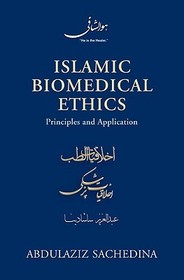
Islamic Biomedical Ethics Principles and Application
- Publisher's listprice GBP 100.00
-
45 150 Ft (43 000 Ft + 5% VAT)
The price is estimated because at the time of ordering we do not know what conversion rates will apply to HUF / product currency when the book arrives. In case HUF is weaker, the price increases slightly, in case HUF is stronger, the price goes lower slightly.
- Discount 10% (cc. 4 515 Ft off)
- Discounted price 40 635 Ft (38 700 Ft + 5% VAT)
Subcribe now and take benefit of a favourable price.
Subscribe
45 150 Ft

Availability
printed on demand
Why don't you give exact delivery time?
Delivery time is estimated on our previous experiences. We give estimations only, because we order from outside Hungary, and the delivery time mainly depends on how quickly the publisher supplies the book. Faster or slower deliveries both happen, but we do our best to supply as quickly as possible.
Product details:
- Publisher OUP USA
- Date of Publication 23 April 2009
- ISBN 9780195378504
- Binding Hardback
- No. of pages296 pages
- Size 160x234x27 mm
- Weight 550 g
- Language English 0
Categories
Short description:
In this pioneering work, Abdulaziz Sachedina relates classic Muslim religious values to the new ethical challenges that arise from medical research and practice. Sachedina's work is unique in that it aims at conversing with Jewish and Christian ethics, moving beyond the Islamic fatwa literature to search for a common language of moral justification and legitimization among the followers of Abrahamic traditions
MoreLong description:
In this pioneering work, Abdulaziz Sachedina relates classic Muslim religious values to the new ethical challenges that arise from medical research and practice. He depends on Muslim legal theory, but moves beyond juridical practice to search for the underlying reasons that determine the rightness or wrongness of a particular action. Drawing on the work of diverse Muslim theologians he outlines a form of moral reasoning that can derive decisions that underscore the spirit of the Shari'a and yet leave room to revisit earlier decisions and formulate new ones that in turn need not be understood as absolute or final. After laying out this methodology, he applies it to a series of ethical questions surrounding the human life cycle from birth to death, including such issues as abortion, euthanasia, and organ donation. Sachedina's work is unique in that it aims at conversing with Jewish and Christian ethics, moving beyond the Islamic fatwa literature to search for a common language of moral justification and legitimization among the followers of Abrahamic traditions.
while clearly directed to an academic audience, nonetheless raises substantive challenges for seular bioethics discourse, health policy, and espeicially for ethical reflection within the Islamic faith community ... Sachedina's is a courageous book. He does not back away from critique of Muslim religious scholarship, which he finds has failed to provide religous and moral empowerment to Muslims in general, and in the health-care context in particular.
Table of Contents:
INTRODUCTION
IN SEARCH OF PRINCIPLES OF HEALTH CARE IN ISLAM
HEALTH AND SUFFERING
BEGINNING OF LIFE
TERMINATING EARLY LIFE
DEATH AND DYING
ORGAN DONATION AND COSMETIC ENHANCEMENT
RECENT DEVELOPMENTS
EPILOGUE
GLOSSARY
END NOTES
SELECT BIBLIOGRAPHY

