

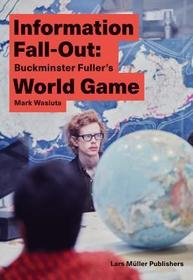
Information Fall–Out – Buckminster Fuller`s World Game
Buckminster Fuller's World Game
- Publisher's listprice GBP 30.00
-
14 332 Ft (13 650 Ft + 5% VAT)
The price is estimated because at the time of ordering we do not know what conversion rates will apply to HUF / product currency when the book arrives. In case HUF is weaker, the price increases slightly, in case HUF is stronger, the price goes lower slightly.
- Discount 10% (cc. 1 433 Ft off)
- Discounted price 12 899 Ft (12 285 Ft + 5% VAT)
Subcribe now and take benefit of a favourable price.
Subscribe
14 332 Ft

Availability
Not yet published.
Why don't you give exact delivery time?
Delivery time is estimated on our previous experiences. We give estimations only, because we order from outside Hungary, and the delivery time mainly depends on how quickly the publisher supplies the book. Faster or slower deliveries both happen, but we do our best to supply as quickly as possible.
Product details:
- Publisher Lars Muller Publishers
- Date of Publication 26 January 2026
- ISBN 9783037785539
- Binding Paperback
- No. of pages320 pages
- Size 250x150x15 mm
- Weight 666 g
- Language English
- Illustrations 150 Abb. 700
Categories
Short description:
Initially proposed for the US Pavilion at Expo 67 in Montreal, Buckminster Fuller's World Game was played for the first time in 1969 in New York. Over the next decade the World Game evolved and expanded. Across its different manifestations the World Game remained focused on the goals of overcoming energy scarcity and altering conventional territorial politics through the redistribution of world resources. This anti-war game was intended to discover the right conditions for perpetual ecological peace.
Mirroring Cold War command and control infrastructures, proposals for World Game centers described a vast computerized network that could process, map, and visualize environmental information drawn from, among other sources, Russian and American spy satellites. Fuller claimed that their optical sensors and thermographic scanners could detect the location and quantity of water, grain, metals, livestock, human populations, or any other conceivable form of energy. Despite its inventor's plans for a photogenic, televisual, and cybernetic form of mass participation, throughout Fuller's life the World Game remained largely speculative and pedagogical. It appeared primarily through copious research reports, resource studies, and ephemeral workshops. This book tracks this textual dimension by assembling documents related to various instances of the World Game conceived, proposed, and played from 1969 to 1982. It examines the World Game as a system for environmental information and as a process of resource administration.
Long description:
Ursprünglich für den US Pavillon an der Expo 1967 in Montreal vorgeschlagen, wurde Buckminster Fullers World Game erstmals 1969 in New York gespielt. Über die nächste Dekade hinweg wurde das World Game stetig weiterentwickelt, ohne seinen Fokus auf die Überwindung der Energieknappheit und die Veränderung der konventionellen territorialen Politik durch Umverteilung der globalen Ressourcen zu verlieren. Das Antikriegsspiel sollte die Voraussetzungen für immerwährenden ökologischen Frieden erkunden. Analog zur Kontrollstruktur des Kalten Krieges beschrieben die Vorschläge für World-Game-Zentren ein ausgedehntes Computernetzwerk, das es erlaubte, Informationen über die Umwelt - die unter anderem von russischen und amerikanischen Spionagesatelliten stammten - zu visualisieren. Fuller behauptete, dass deren optische Sensoren und thermographischen Scanner den Ort und die Menge von Wasser, Getreide, Metallen, Nutztieren, Einwohnern und alle anderen denkbaren Formen von Energie aufspüren könnten. Trotz Fullers Plänen für eine breite Beteiligung der Bevölkerung blieb das World Game zu seiner Lebenszeit sehr spekulativ und pädagogisch. Es zeigte sich hauptsächlich in ausufernden Forschungsberichten und kurzlebigen Seminaren. Dieser textuellen Dimension geht das Buch mittels einer Sammlung von Dokumenten nach, welche die verschiedenen Gelegenheiten belegen, bei denen das World Game zwischen 1694 und 1982 besprochen und gespielt wurde. Das Buch untersucht das World Game als eine Systematik der Umweltinformationen und als Prozess der Ressourcenverwaltung.
More
