

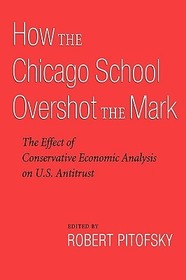
How the Chicago School Overshot the Mark
The Effect of Conservative Economic Analysis on U.S. Antitrust
- Publisher's listprice GBP 52.00
-
24 843 Ft (23 660 Ft + 5% VAT)
The price is estimated because at the time of ordering we do not know what conversion rates will apply to HUF / product currency when the book arrives. In case HUF is weaker, the price increases slightly, in case HUF is stronger, the price goes lower slightly.
- Discount 10% (cc. 2 484 Ft off)
- Discounted price 22 359 Ft (21 294 Ft + 5% VAT)
Subcribe now and take benefit of a favourable price.
Subscribe
24 843 Ft

Availability
printed on demand
Why don't you give exact delivery time?
Delivery time is estimated on our previous experiences. We give estimations only, because we order from outside Hungary, and the delivery time mainly depends on how quickly the publisher supplies the book. Faster or slower deliveries both happen, but we do our best to supply as quickly as possible.
Product details:
- Edition number and title quality of products lower
- Publisher OUP USA
- Date of Publication 25 September 2008
- ISBN 9780195339765
- Binding Paperback
- No. of pages328 pages
- Size 231x155x22 mm
- Weight 476 g
- Language English 0
Categories
Long description:
How the Chicago School Overshot the Mark is about the rise and recent fall of American antitrust. It is a collection of 15 essays, almost all expressing a deep concern that conservative economic analysis is leading judges and enforcement officials toward an approach that will ultimately harm consumer welfare.
For the past 40 years or so, U.S. antitrust has been dominated intellectually by an unusually conservative style of economic analysis. Its advocates, often referred to as "The Chicago School," argue that the free market (better than any unelected band of regulators) can do a better job of achieving efficiency and encouraging innovation than intrusive regulation. The cutting edge of Chicago School doctrine originated in academia and was popularized in books by brilliant and innovative law professors like Robert Bork and Richard Posner. Oddly, a response to that kind of conservative doctrine may be put together through collections of scores of articles but until now cannot be found in any one book. This collection of essays is designed in part to remedy that situation.
The chapters in this book were written by academics, former law enforcers, private sector defense lawyers, Republicans and Democrats, representatives of the left, right and center. Virtually all agree that antitrust enforcement today is better as a result of conservative analysis, but virtually all also agree that there have been examples of extreme interpretations and misinterpretations of conservative economic theory that have led American antitrust in the wrong direction. The problem is not with conservative economic analysis but with those portions of that analysis that have "overshot the mark" producing an enforcement approach that is exceptionally generous to the private sector. If the scores of practices that traditionally have been regarded as anticompetitive are ignored, or not subjected to vigorous enforcement, prices will be higher, quality of products lower, and innovation diminished. In the end consumers will pay.
Chairman Pitofsky's timely book teaches us important truths about antitrust. This book convincingly rebuts the Chicago School approach to economics and competition policy while reminding us that the antitrust laws, when effectively applied, are robust tools that enhance competition and benefit consumers. Chairman Pitofsky and the other distinguished contributors provide a badly needed counterpoint to the excesses of Chicago School economic theory that has led to an overly hands-off and lifeless approach to antitrust enforcement in recent years. This excellent volume should be studied by all those who care about competition policy.
Table of Contents:
Introduction: Setting the Stage
Conservative Economic Analysis and its Effects
Is Efficiency All that Counts?
Chicago School and Dominant Firm Behavior
Are Conservatives Correct that Vertical Arrangements (Merger and Distribution) Can Very Rarely Injure Consumer Welfare?
Has the Free Rider Explanation for Vertical Arrangements Been Unrealistically Expanded?
Reinvigorating Merger Enforcement that has Declined as a Result of Conservative Economic Analysis

