

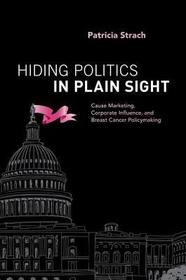
Hiding Politics in Plain Sight
Cause Marketing, Corporate Influence, and Breast Cancer Policymaking
- Publisher's listprice GBP 30.99
-
13 991 Ft (13 325 Ft + 5% VAT)
The price is estimated because at the time of ordering we do not know what conversion rates will apply to HUF / product currency when the book arrives. In case HUF is weaker, the price increases slightly, in case HUF is stronger, the price goes lower slightly.
- Discount 10% (cc. 1 399 Ft off)
- Discounted price 12 592 Ft (11 993 Ft + 5% VAT)
Subcribe now and take benefit of a favourable price.
Subscribe
13 991 Ft

Availability
printed on demand
Why don't you give exact delivery time?
Delivery time is estimated on our previous experiences. We give estimations only, because we order from outside Hungary, and the delivery time mainly depends on how quickly the publisher supplies the book. Faster or slower deliveries both happen, but we do our best to supply as quickly as possible.
Product details:
- Publisher OUP USA
- Date of Publication 6 October 2016
- ISBN 9780190606855
- Binding Paperback
- No. of pages256 pages
- Size 231x155x15 mm
- Weight 386 g
- Language English 0
Categories
Short description:
Hiding Politics in Plain Sight examines the costs of market mechanisms, especially cause marketing as a strategy for change. Industry and corporate-connected individuals use market mechanisms to brand issues like breast cancer widely, shaping public understanding. But framed as consensus-based social issues rather than contentious political issues, they essentially hide politics in plain sight.
MoreLong description:
As late as the 1980s, breast cancer was a stigmatized disease, so much so that local reporters avoided using the word "breast" in their stories and early breast cancer organizations steered clear of it in their names. But activists with business backgrounds began to partner with corporations for sponsored runs and cause-marketing products, from which a portion of the proceeds would benefit breast cancer research. Branding breast cancer as "pink"--hopeful, positive, uncontroversial--on the products Americans see every day, these activists and corporations generated a pervasive understanding of breast cancer that is widely shared by the public and embraced by policymakers. Clearly, they have been successful: today, more Americans know that the pink ribbon is the symbol of breast cancer than know the name of the vice president.
Hiding Politics in Plain Sight examines the costs of employing market mechanisms--especially cause marketing--as a strategy for change. Patricia Strach suggests that market mechanisms do more than raise awareness of issues or money to support charities: they also affect politics. She shows that market mechanisms, like corporate-sponsored walks or cause-marketing, shift issue definition away from the contentious processes in the political sphere to the market, where advertising campaigns portray complex issues along a single dimension with a simple solution: breast cancer research will find a cure and Americans can participate easily by purchasing specially-marked products. This market competition privileges even more specialized actors with connections to business. As well, cooperative market activism fundamentally alters the public sphere by importing processes, values, and biases of market-based action into politics. Market activism does not just bring social concerns into market transactions, it also brings market biases into public policymaking, which is inherently undemocratic. As a result, industry and key activists work cooperatively rather than contentiously, and they define issues as consensual rather than controversial, essentially hiding politics in plain sight.
Patricia Strach has given us a new lens through which to see some of the more subtle but most powerful elements of corporate influence: framing complex issues as simple, deathly ones as hopeful and optimistic, and conflictual ones as simply not worth worrying about.
Table of Contents:
Acknowledgments
Chapter 1 Introduction
Chapter 2 Foundations: Cause Marketing, Breast Cancer, and Framing in America
Chapter 3 Cooperative Market Mechanisms
Chapter 4 Telling Stories
Chapter 5 Effects
Chapter 6 Defining Issues: Breast Cancer and the Creation of Consensus Politics
Chapter 7 Hiding Politics in Plain Sight
Appendix A Model Details for Chapter 3
Appendix B Regression Results for Chapter 5
Appendix C Notes on Methodology and Sources
Appendix D Citizen Consumer Survey
Notes
References
Index

