

- Publisher's listprice GBP 62.00
-
29 620 Ft (28 210 Ft + 5% VAT)
The price is estimated because at the time of ordering we do not know what conversion rates will apply to HUF / product currency when the book arrives. In case HUF is weaker, the price increases slightly, in case HUF is stronger, the price goes lower slightly.
- Discount 10% (cc. 2 962 Ft off)
- Discounted price 26 658 Ft (25 389 Ft + 5% VAT)
Subcribe now and take benefit of a favourable price.
Subscribe
29 620 Ft

Availability
printed on demand
Why don't you give exact delivery time?
Delivery time is estimated on our previous experiences. We give estimations only, because we order from outside Hungary, and the delivery time mainly depends on how quickly the publisher supplies the book. Faster or slower deliveries both happen, but we do our best to supply as quickly as possible.
Product details:
- Publisher OUP USA
- Date of Publication 17 April 2014
- ISBN 9780199340965
- Binding Paperback
- No. of pages384 pages
- Size 251x175x27 mm
- Weight 612 g
- Language English 0
Categories
Short description:
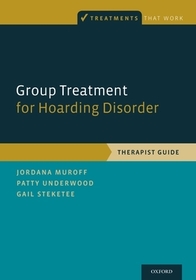
Group Treatment for Hoarding Disorder: Therapist Guide outlines a cognitive-behavioral therapy program for HD using a group model.
MoreLong description:
For the first time, Hoarding Disorder (HD) is now recognized as a distinct disorder in the fifth edition of the Diagnostic and Statistical Manual of Mental Disorders (DSM-5), separate from OCD. HD has also received much more attention and exposure in recent years. Consequently, more people will be recommended for treatment, increasing the demand and need for clinicians who deliver this specialized intervention.
Group Treatment for Hoarding Disorder: Therapist Guide outlines a cognitive-behavioral therapy program for HD using a group model. Clinicians deliver group therapy over 20 weekly sessions of 1.5 to 2 hours each. A single experienced clinician can lead the group or a co-therapy model can be used with two clinicians, one experienced and one in training. Groups of 6 to 8 participants:
DT receive education about HD and about the CBT model
DT discuss therapy goals and personal values
DT practice motivational enhancement methods including identifying barriers to progress
DT receive training in organizing and problem-solving about hoarding problems
DT learn cognitive therapy strategies to reduce problematic hoarding beliefs and to replace acquiring with more adaptive behaviors
DT practice sorting, removing clutter, and not acquiring, beginning with easier tasks
DT and identify in-home supports.
Final sessions focus on reviewing the most effective therapy methods, coping with change, and highlighting strategies for maintaining gains. Group members use the Treatment for Hoarding Disorder: Workbook, Second Edition to assist with practice exercises. All of the necessary forms and worksheets are provided in the books and online. Treatment proceeds in a flexible session-by-session fashion with attention to group process. Written for psychologists, social workers, psychiatrists, counselors, and psychiatric nurses, this Therapist Guide will promote effective group treatment of people with hoarding disorder.
Table of Contents:
Acknowledgments
Chapter 1 Introduction
Chapter 2 Group Formation and Assessment
Chapter 3 Group Process
Chapter 4 Session 1: Introduction and Education
Chapter 5 Session 2: Model Building
Chapter 6 Session 3: Motivation
Chapter 7 Session 4: Goals and Treatment Planning
Chapter 8 Session 5: Reducing Acquisition
Chapter 9 Session 6: More on Acquisition
Chapter10 Session 7: Exposure Practice for Non-Acquisition
Chapter 11 Session 8: Decisions about Saving and Discarding
Chapter 12 Session 9: More on Decisions about Saving and Discarding
Chapter 13 Session 10: Skills Training for Organizing
Chapter 14 Session 11: Organizing Paper
Chapter 15 Session 12: Cognitive Strategies
Chapter 16 Session 13: Cognitive Therapy Skills for Letting Go
Chapter 17 Session 14: Coaching and Letting Go
Chapter 18 Session 15: Non-Acquisition Practice
Chapter 19 Session 16: Barriers to Progress
Chapter 20 Session 17: Maintaining Systems and Gains
Chapter 21 Session 18: Review of Treatment Methods
Chapter 22 Session 19: Assessment and Review of Progress
Chapter 23 Session 20: Graduation and Next Steps
Appendices
1. Hoarding Interview
2. Hoarding Rating Scale
3. Saving Inventory - Revised (SI-R)
4. Clutter Image Rating (CIR) Instructions, and pictures of LR, Kit, BR
5. Saving Cognitions Inventory (SCI)
6. Activities of Daily Living for Hoarding (ADL-H)
7. Safety Questions
8. Home Environment Inventory (HEI)
9. Binder Information Sheet (Session 1)
10. Session schedule (Session 1)
11. Group Session Forms [samples for each session]
12. Group Session Form [blank]
13. Confidentiality contract (Session 1)
14. Hoarding Disorder DSM-5 Criteria (Session 1)
15. Clinician's Group Progress Notes
16. Clinician's Group Progress Note [Example]
17. Blank Hoarding Model (Workbook, Ch. 3, p.31)
18. Brief Thought Record (Workbook, Ch. 3, p. 37)
19. Clutter Visualization Form (Workbook Ch. 4, p. 44)
20. Unclutter Visualization Form (Workbook, Ch. 4, p. 45)
21. Table of Signals of Ambivalence and Strategies (Session 3)
22. Table of Motivational Enhancement Strategies (Session 3)
23. Advantages and Disadvantages of Change Worksheet (Session 3)
24. Instructions to Coaches
25. Acquiring Form (Workbook, Ch. 5, p. 52)
26. Acquiring Visualization Form (Workbook, Ch. 4, p. 46)
27. Thought Listing Exercise Form (Session 8)
28. Behavioral Experiment Form (Workbook, Ch. 7, p. 83)
29. Table of Problematic Thinking Styles (Session 12; Workbook, Ch. 8, p. 86)
30. Thought Record (Workbook, Ch. 8, p. 93)
31. Non-acquiring Help Card (Session 15)
32. Practice Form (Workbook, Ch. 4, p. 47)
33. Personal worksheet for managing barriers (Session 16)
34. Family Response to Hoarding Scale (FRHS) (Session 16)
35. Weekly Scheduler (Session 17)
36. List of Treatment Techniques (Session 18)
37. Certificate of completion (Session 20)
References
Readings and Resources
About the Authors
Index

