

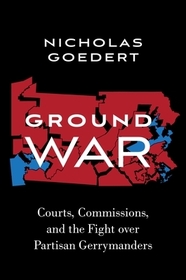
Ground War
Courts, Commissions, and the Fight over Partisan Gerrymanders
- Publisher's listprice GBP 26.49
-
12 655 Ft (12 052 Ft + 5% VAT)
The price is estimated because at the time of ordering we do not know what conversion rates will apply to HUF / product currency when the book arrives. In case HUF is weaker, the price increases slightly, in case HUF is stronger, the price goes lower slightly.
- Discount 10% (cc. 1 266 Ft off)
- Discounted price 11 389 Ft (10 847 Ft + 5% VAT)
Subcribe now and take benefit of a favourable price.
Subscribe
12 655 Ft

Availability
Estimated delivery time: In stock at the publisher, but not at Prospero's office. Delivery time approx. 3-5 weeks.
Not in stock at Prospero.
Why don't you give exact delivery time?
Delivery time is estimated on our previous experiences. We give estimations only, because we order from outside Hungary, and the delivery time mainly depends on how quickly the publisher supplies the book. Faster or slower deliveries both happen, but we do our best to supply as quickly as possible.
Product details:
- Publisher OUP USA
- Date of Publication 27 May 2022
- ISBN 9780197626634
- Binding Paperback
- No. of pages280 pages
- Size 157x237x16 mm
- Weight 463 g
- Language English 232
Categories
Short description:
In Ground War, Nicholas Goedert tackles the controversies, litigation, and effects surrounding partisan gerrymandering of Congress. He contends that the appropriate actors to address the fairness of a map are nonpartisan commissions within each state, not the US courts. Using multiple empirical approaches, Goedert shows that nonpartisan commissions, adopted state-by-state, represent the best alternative to legislative districting. A rigorous account that explains how our system works and provides practical solutions for improving it, Ground War is an essential work for all scholars of US elections.
MoreLong description:
Partisan gerrymandering, the drawing of legislative district lines to deliberately favor one political party, has been present and controversial in American politics since before the ratification of our Constitution. Yet in the past couple of decades, parties in power at the state level have developed greater expertise than ever before at redistricting to their own advantage. Since 2010, a series of legislative, electoral, and judicial events have given this issue a prominence it has never before seen, especially as it applies to the United States Congress.
In Ground War, Nicholas Goedert tackles the controversies, litigation, and effects surrounding partisan gerrymandering of Congress. He contends that the appropriate actors to address the fairness of a map are nonpartisan commissions within each state, not the US courts. Goedert illustrates how existing measures and legal standards are too narrow--while they are well-adapted to evaluating maps in swing states in close elections, they fail to properly address states or national electoral environments that favor one party. In turn, Goedert demonstrates that the bias and responsiveness of partisan maps is highly sensitive to both the make-up of a state's electorate and the ephemeral election conditions under which individual elections take place. But this does not mean that partisan gerrymandering must be excused as a dilemma without a reasonable remedy. Using multiple empirical approaches and a novel metric to measure the partisan fairness of maps, Ground War shows that nonpartisan commissions, adopted state-by-state, represent the best alternative to legislative districting. These commissions foster competitive elections, produce unbiased delegations, and give consideration to representational claims distinctive to each state. A rigorous account that explains how our system works and provides practical solutions for improving it, Ground War is an essential work for all scholars of US elections.
Ground War provides a fresh and nuanced examination of gerrymandering right in time for the next round of redistricting battles. With sophisticated empirical analyses, masterful discussion of legal developments, and a novel measure of electoral maps' partisan bias and competitiveness, Goedert presents a compelling take on the ways in which gerrymandering shapes our democracy. Moreover, these analyses thoughtfully build to policy recommendations that could increase the competitiveness and representativeness of our national and state legislatures. In short, this book is a must-read for scholars of elections, election law, and legislative politics.
Table of Contents:
1. Introduction: A Tale of Two Gerrymanders
2. The Theory Behind Gerrymandering
3. Legal Developments and Standards in Partisan Gerrymandering
4. Gerrymandering and Competitive Elections
5. Measuring Historical Bias: Historically Weighted Efficiency Gap
6. Bias and Responsiveness in Partisan Maps
7. Bias and Responsiveness in Nonpartisan Maps
8. Conclusion: The Road to Reform
References
Appendices

