

- Publisher's listprice GBP 67.00
-
30 250 Ft (28 810 Ft + 5% VAT)
The price is estimated because at the time of ordering we do not know what conversion rates will apply to HUF / product currency when the book arrives. In case HUF is weaker, the price increases slightly, in case HUF is stronger, the price goes lower slightly.
- Discount 10% (cc. 3 025 Ft off)
- Discounted price 27 225 Ft (25 929 Ft + 5% VAT)
Subcribe now and take benefit of a favourable price.
Subscribe
30 250 Ft

Availability
printed on demand
Why don't you give exact delivery time?
Delivery time is estimated on our previous experiences. We give estimations only, because we order from outside Hungary, and the delivery time mainly depends on how quickly the publisher supplies the book. Faster or slower deliveries both happen, but we do our best to supply as quickly as possible.
Product details:
- Publisher OUP Oxford
- Date of Publication 11 July 2002
- ISBN 9780199254040
- Binding Paperback
- No. of pages408 pages
- Size 234x157x22 mm
- Weight 579 g
- Language English
- Illustrations numerous tables and figures 0
Categories
Short description:
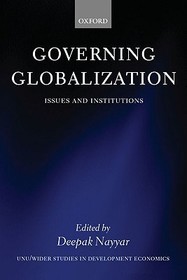
This timely book is among the first to examine in depth the governance needs of the world economy and polity. It evaluates the experience of institutions, with a focus on the UN, the IMF, the World Bank, and the WTO, to sketch the contours of reform and change necessary in the existing system. It analyses issues of emerging significance, such as global macroeconomic management, transnational corporations, international capital movements, and cross-border movements of people, to suggest that there are some missing institutions which are needed.
MoreLong description:
It is now more than fifty years since the United Nations system and the Bretton Woods institutions were created. The world has changed since then, and so have its governance needs in terms of institutions and rules. It is time to think about the contours of institutions and governance that would meet the needs of the world economy, and also polity, at least for the first quarter of the twenty-first century. This book is among the first to examine the subject in depth.
The study is divided into four parts. The first situates the subject in the wider context of globalization which has shaped development in the world economy, affected the living conditions of people, and constrained the role of nation states. The international context and the national setting are explored. The second part analyses some issues of emerging significance in the contemporary world, such as global macroeconomic management, transnational corporations, international capital flows, and cross-border movements of people, to suggest that there are some missing institutions which are needed. The third part provides a critical evaluation of the existing institutions, in retrospect, with a focus on the UN, the IMF, the World Bank, and the WTO. It analyses how existing rules need to be modified or existing institutions need to be restructured to meet the present and future needs of global governance. The fourth part explores some important elements of governance which are critical for any vision of the future. It suggests some changes in existing institutions and points to emerging governance needs where new institutions may have to be created.
This authoritative volume will be of value to readers with an interest in international economics, development economics, and international relations. It will also be of value to practitioners, both policy-makers and diplomats, concerned with problems of global governance, and should become the standard reference on the subject.
... excellent ... In a world shaped by Gradgrindian economic rationalism research that seeks to redress the devastating social and distributional inequities determined by those policies is a refreshing stimulus for political and economic policy change. This is an invaluable text for the theorist, policy maker and teacher seeking to understand the mechanisms of international institutional intervention.
Table of Contents:
Part I: Context
Introduction
Nationalism and Economic Policy in the Era of Globalization
Part II: Issues
Global Macroeconomic Management
Transnational Corporations and Technology Flows
Capital Flows to Developing Countries and the Reform of the International Financial System
Cross-Border Movements of People
Part III: Institutions
The United Nations System: Prospects for Renewal
The Bretton Woods Institutions: Evolution, Reform, and Change
Globalization and the Logic of International Collective Action: Re-examining the Bretton Woods Institutions
From GATT to WTO and Beyond
Part IV: Governance
Reforming the International Financial Architecture: Consensus and Divergence
Developing Countries in Global Economi Governance and Negotiation Processes
Processes of Change in International Organizations
The Existing System and the Missing Institutions

