

- Publisher's listprice EUR 49.95
-
19 510 Ft (18 581 Ft + 5% VAT)
The price is estimated because at the time of ordering we do not know what conversion rates will apply to HUF / product currency when the book arrives. In case HUF is weaker, the price increases slightly, in case HUF is stronger, the price goes lower slightly.
- Discount 20% (cc. 3 902 Ft off)
- Discounted price 15 608 Ft (14 865 Ft + 5% VAT)
- Discount is valid until: 30 June 2026
Subcribe now and take benefit of a favourable price.
Subscribe
19 510 Ft

Availability
printed on demand
Why don't you give exact delivery time?
Delivery time is estimated on our previous experiences. We give estimations only, because we order from outside Hungary, and the delivery time mainly depends on how quickly the publisher supplies the book. Faster or slower deliveries both happen, but we do our best to supply as quickly as possible.
Product details:
- Edition number 1
- Publisher Mercury Learning and Information
- Date of Publication 1 April 2024
- ISBN 9781501522741
- Binding Paperback
- No. of pages192 pages
- Size 250x150x15 mm
- Weight 292 g
- Language English 492
Categories
Long description:
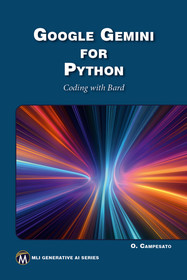
This book provides a bridge between the worlds of Python 3 programming and Generative AI, aiming to equip readers with the skills to navigate both domains with confidence. It begins with an introduction to fundamental aspects of Python programming, which include various data types, number formatting, Unicode and UTF-8 handling, and text manipulation techniques. In addition, you will learn about loops, functions, data structures, NumPy, Pandas, conditional logic, and reserved words in Python. Further chapters show how to handle user input, manage exceptions, and work with command-line arguments. The text then transitions to the realm of Generative AI, discussing its distinction from Conversational AI. Popular platforms and models, including Bard (now called “Gemini”) and its competitors, are presented to give readers an understanding of the current AI landscape. The book discusses the capabilities of Bard, its strengths, weaknesses, and potential applications. Finally, you will learn how to generate a variety of Python 3 code samples via Bard.
More
