

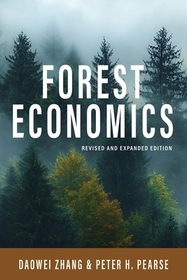
Forest Economics, Revised and Expanded Edition
- Publisher's listprice GBP 46.00
-
21 976 Ft (20 930 Ft + 5% VAT)
The price is estimated because at the time of ordering we do not know what conversion rates will apply to HUF / product currency when the book arrives. In case HUF is weaker, the price increases slightly, in case HUF is stronger, the price goes lower slightly.
- Discount 10% (cc. 2 198 Ft off)
- Discounted price 19 779 Ft (18 837 Ft + 5% VAT)
Subcribe now and take benefit of a favourable price.
Subscribe
21 976 Ft

Availability
Estimated delivery time: In stock at the publisher, but not at Prospero's office. Delivery time approx. 3-5 weeks.
Not in stock at Prospero.
Why don't you give exact delivery time?
Delivery time is estimated on our previous experiences. We give estimations only, because we order from outside Hungary, and the delivery time mainly depends on how quickly the publisher supplies the book. Faster or slower deliveries both happen, but we do our best to supply as quickly as possible.
Product details:
- Edition number 2
- Publisher University of British Columbia Press
- Date of Publication 30 January 2026
- ISBN 9780774872898
- Binding Paperback
- No. of pages533 pages
- Size 229x152 mm
- Weight 700 g
- Language English
- Illustrations 80 charts, 31 tables 692
Categories
Long description:
A firm grounding in economics is integral to sound forest management, investment, policies, and practices. Forest Economics covers the basic economic concepts, principles, and constructs and shows how these are applied in private and public forestry decision making.
This comprehensive edition contains up-to-date data, examples, and applications of economic principles, along with literature and study questions, and additional valuable content in several key areas:
- forest finance and forestland investment/ownership, including financial economic models
- simple interest rate and risk measurements
- market distortion
- consumer theory
- priced non-timber values and payment for ecosystem services
- land rent theory
- the economics of forest management planning and forest health/wildfire economics
- an international comparison of forest taxes and fees
- property rights beyond the private/public ownership binary
- the measurement of competitiveness in international trade
- a new theory of foreign direct investment.
The advanced empirical presentation and keen attention to new developments in the field reflect the authors' decades of teaching experience in the United States and Canada. Forest Economics is quite simply indispensable.
MoreTable of Contents:
Forewords / Peter Deegen and Michael Jacobson
Preface
Conversion Factors
PART 1 – Markets, Government, and Forest Investment Analysis
1 Forestry's Economic Perspective
Forestry from an Economic Viewpoint
Basic Economic Questions
Mixed Capitalism and the Role of Government
Economic Objectives: Efficiency and Equity
Forests as Economic Resources
Why Forest Economics?
Economic and Financial Decision Making
2 Market Economies and the Government
Economic Efficiency and Opportunity Costs
The Theory of Production
Allocating Inputs Among Alternative Uses
An Example
Comsumer Theory
Supply, Demand, and Price Equilibrium
Market Failures and Externalities in Forestry
Government Intervention and Policy Failure
3 Forest Investment Analysis and Valuation
Time and the Role of Interest
Compounding, Discounting, and Present Values
Criteria for Investment Decisions
Risk and Uncertainty
Integrating Economics with Silviculture
Valuing Pre-Merchantable Timber
Taxes and Social Considerations
PART 2 – The Forest Sector: Land Timber, and Non-Timber Forest Values
4 Timber Supply, Demand, and Pricing
The Forest Products Sector
Forest Products Supply and Demand
The Demand for Timber
Timber Supply
Long-Run Wood Supply Projections
Determinants of Stumpage Prices
Price Distortions
5 Non-Timber Forest Values
Priced Non-Timber Forest Values
Unpriced Values: A Problem of Measurement
Consumer Surplus as a Measure of Value
Evaluating Unpriced Recreation
Other Considerations in Valuing Recreational Resources
Externalities, Intrinsic Value, and Other Complications
6 Land Allocation and Multiple Use
Land Rent and Land Value
Intensity of Land Use
Extensive Margin of Land Use
Allocation among Uses
Combinations of Uses
Practical Difficulties
An Illustration: Payments for Environmental Services on Private Lands
PART 3 – The Economics of Forest Management
7 The Optimal Forest Rotation
Optimal Rotation in Discrete Format
Optimal Rotation Age in Continuous Format
Cutting Cycle for an Uneven-Aged Stand
Comparisons with Other Rotation Criteria
Other Impacts on the Optimal Rotation
Hartman Rotation Age
8 Forest Management Planning, Regulating Harvests over Time, and Wildfire Economics
The Stand and the Forest
Economics of Forest Management Planning: Maximizing Forest Asset Value
Regulating Forest Harvest over Time: Market Solutions and Limitations
The Regulated Forest
Transition to a Normal Forest
Sustained Yield Rationale and Critique
Timber Harvests over Time in the Absence of Sustained Yield Policy: Market as a Regulator
Forest Health Economics: The Case of Wildfire Management
9 Long-Term Trends in the Forest Sector and Silvicultural Investment
Long-Term Trends in the Forest Sector
A Conceptual Model for Silvicultural Investment
Factors Influencing Silvicultural Investment on Private Lands
Silvicultural Investment on Public Lands
Planted Forest Development in the Southern United States
PART 4 – Economics of Forest Policy and Forestland Investments
10 Property Rights
Property Rights, Property Value, and Economic Efficiency
Evolution of Forest Property Rights
Dimensions of Property and Their Economic Implications
Common Forms of Forest Tenure
Economic Issues of Tenure Systems
Two Examples
Byond the Binary of Private and Public Ownership
11 Forest Taxes and Other Charges
Characteristics of Forest Charges
Property Taxes
Levies on Harvests or Timber to Be Harvested
Charges for Rights: Land Rentals and Fees
Forest Tax-Related Issues in the United States
Tax Incidence and Deadweight Loss
Other Economic Considerations
12 Forestland Investments
Types of Forestland Ownership
Efficient Portfolio Theory and Asset Pricing Models
The Rise and Fall of Industrial Forestland Ownership
The Rise of Institutional Forestland Ownership
Empirical Evidence: The Financial Performance of Forestland Investments
Summary
Appendix
PART 5 – Forest Economics in Global Perspective
13 Forest Products Trade
Trends in International Forest Products Trade
Comparative Advantage and the Principle of Specialization
Production Possibilities and Terms of Bilateral Trade
Factors Influencing International Forest Products Trade
The Political Economy of Trade Restrictions
Measuring Competitiveness in Forest Products Trade
Foreign Direct Investment in the Forest Industry
14 Global Forest Resources and the Environment
Global Forest Resources
Population, Economic Growth, and the Environment
Forest-Based Industrialization and Tropical Deforestation
Forests and Climate Change
Emerging Issues in Forest Economics
Answers to Numerical Review Questions
Index

