

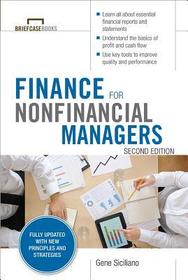
Finance for Nonfinancial Managers, Second Edition (Briefcase Books Series)
Series: BUSINESS BOOKS;
- Publisher's listprice GBP 15.99
-
7 639 Ft (7 275 Ft + 5% VAT)
The price is estimated because at the time of ordering we do not know what conversion rates will apply to HUF / product currency when the book arrives. In case HUF is weaker, the price increases slightly, in case HUF is stronger, the price goes lower slightly.
- Discount 10% (cc. 764 Ft off)
- Discounted price 6 875 Ft (6 548 Ft + 5% VAT)
Subcribe now and take benefit of a favourable price.
Subscribe
7 639 Ft

Availability
Estimated delivery time: In stock at the publisher, but not at Prospero's office. Delivery time approx. 3-5 weeks.
Not in stock at Prospero.
Why don't you give exact delivery time?
Delivery time is estimated on our previous experiences. We give estimations only, because we order from outside Hungary, and the delivery time mainly depends on how quickly the publisher supplies the book. Faster or slower deliveries both happen, but we do our best to supply as quickly as possible.
Product details:
- Edition number 2
- Publisher McGraw-Hill Education
- Date of Publication 16 September 2014
- ISBN 9780071824361
- Binding Paperback
- No. of pages272 pages
- Size 228x152x15 mm
- Weight 324 g
- Language English 0
Categories
Short description:
More than 700,000 Briefcase Books sold! One of the top-selling books in the series has been updated to help managers make the best financial decisions possible
MoreLong description:
AN INTRODUCTION TO FINANCIAL REPORTS--WITH NEW TACTICSFOR BUDGETING AND PINPOINTING KEY FINANCIAL AREAS
Financial decisions impact virtually every area of your company. As a manager, it's up to you to understand how and why.
Finance for Nonfinancial Managers helps you understand the information in essential financial reportsand then shows you how to use that understanding to make informed, intelligent decisions. It provides a solid working knowledge of:
- Basic Financial Reports--All about balance sheets, income statements, cash flow statements, and more
- Cost Accounting--Methods to assess which products or services are most profitable to your firm
- Operational Planning and Budgeting--Ways to use financial knowledge to strengthen your company
Briefcase Books, written specifically for today's busy manager, feature eye-catching icons, checklists, and sidebars to guide managers step-by-step through everyday workplace situations. Look for these innovative design features to help you navigate through each page:
Key Terms: Clear defi nitions of key terms and concepts
Smart Managing: Tactics and strategies for managing change
Tricks of the Trade: Tips for executing the tactics in the book
Mistake Proofing: Practical advice for minimizing the possibility of error
Caution: Warning signs for when things are about to go wrong
For Example: Examples of successful change-management tactics
Tools: Specific planning procedures, tactics, and hands-on techniques
AN INTRODUCTION TO FINANCIAL REPORTS--WITH NEW TACTICSFOR BUDGETING AND PINPOINTING KEY FINANCIAL AREAS
Financial decisions impact virtually every area of your company. As a manager, it's up to you to understand how and why.
Finance for Nonfinancial Managers helps you understand the information in essential financial reportsand then shows you how to use that understanding to make informed, intelligent decisions. It provides a solid working knowledge of:
- Basic Financial Reports--All about balance sheets, income statements, cash flow statements, and more
- Cost Accounting--Methods to assess which products or services are most profitable to your firm
- Operational Planning and Budgeting--Ways to use financial knowledge to strengthen your company
Briefcase Books, written specifically for today's busy manager, feature eye-catching icons, checklists, and sidebars to guide managers step-by-step through everyday workplace situations. Look for these innovative design features to help you navigate through each page:
Key Terms: Clear defi nitions of key terms and concepts
Smart Managing: Tactics and strategies for managing change
Tricks of the Trade: Tips for executing the tactics in the book
Mistake Proofing: Practical advice for minimizing the possibility of error
Caution: Warning signs for when things are about to go wrong
For Example: Examples of successful change-management tactics
Tools: Specific planning procedures, tactics, and hands-on techniques
MoreTable of Contents:
Introduction ix
1. Counting the Beans: Why Good Financial InformationIs Critical to You 1
Managing a Company in Today’s Business Environment 1
The Role of the Finance Department 4
The Wonder Widget Company Is Our Guide 7
The “Rules” of Financial Reporting 8
The Relationship of Finance and Accounting tothe Other Departments 10
Manager’s Checklist for Chapter 1 11
2. The Structure and Interrelationship of Financial Statements 13
Tracking a Company’s Lifecycle 15
Accounting Is Like a Football Game on Your DVR 16
The Chart of Accounts: A Collection of Buckets 20
The General Ledger: Balancing the Buckets 23
Accrual Accounting: Say What? 25
The Principal Financial Statements Defined 27
Manager’s Checklist for Chapter 2 29
3. The Balance Sheet: A Basic Summary of Value and Ownership 31
Assets and Ownership: They Really Do Balance! 31
Current Assets: Liquidity Makes Things Flow 33
Fixed Assets: Property and Possessions 39
Other Assets: The “Everything Else” Category 40
Current Liabilities: Repayment Is Key 41
Long-Term Liabilities: Borrowed Capital 44
Ownership Comes in Various Forms 45
Capital Stock Comes in Several Flavors 46
Using This Report Effectively 48
Manager’s Checklist for Chapter 3 48
4. The Income Statement: The Flow of Progress 51
They Say Timing Is Everything—And They're Right! 51
Sales: Grease for the Engine 55
Cost of Sales: What It Takes to Earn the Sale 55
Gross Profit: The First Measure of Profitability 58
Operating Expenses: Running the Business 58
Operating Income: The Basic Business Bottom Line 60
EBITDA—He Bit Who? 61
Other Income and Expenses: Not Just Odds and Ends 62
Income Before Taxes, Income Taxes, and Net Income 63
Earnings per Share, Before and After Dilution—What? 63
Using This Report Effectively 66
Manager’s Checklist for Chapter 4 66
5. Profit vs. Cash Flow: What’s the Difference—and Who Cares? 67
The Cash Flow Cycle 68
Cash Basis vs. Accrual Basis 74
Net Profit vs. Cash Flow in Your Financial Reports 75
Manager’s Checklist for Chapter 5 78
6. The Statement of Cash Flow: Tracking the King 81
Beginning Where the Income Statement Ends 83
Cash from Operations: Running the Business 86
Cash for Investing: Building the Business 90
Cash from Financing: Capitalizing the Business 92
Using This Report Effectively 94
Manager’s Checklist for Chapter 6 95
7. Key Performance Indicators: Finding the“Hidden” Information 97
What Are KPIs? Do They Mix with Water? 98
Measures of Financial Condition and Net Worth 98
Measures of Profitability 103
Measures of Financial Leverage 106
Measures of Productivity Metrics 109
Trend Reporting: Using History to Predict the Future 113
Manager’s Checklist for Chapter 7 117
8. Cost Accounting: A Really Short Course inManufacturing Productivity 119
The Purpose of Cost Accounting—Strictly for Insiders 120
Fixed and Variable Expenses in the Factory 124
Controllable and Uncontrollable Expenses 127
Standard Costs—Little Things Mean a Lot 129
Manufacturing Cost Variances: Analysis for Action 130
Manager’s Checklist for Chapter 8 133
9. Good Investment or Bad? How Do You Decide? 135
Capital Investment: A Game of Choices, Risks, andHoped-For Outcomes 136
Return on Investment: The Concept and the Purpose 137
Payback Period: A Quick and Easy Way to Understandthe Approach 138
The Time Value of Money: Today and in the Future 139
Discounted Cash Flow: Evaluating Long-Term Investments 141
Weighted Average Cost of Capital: Enhancing theReturn to Shareholders 143
Internal Rate of Return: Deciding What ReturnIs Good Enough 145
Risk Management: Assessing the Probability ThatWe Might Be Wrong 146
Manager’s Checklist for Chapter 9 147
10. Get to Breakeven First! 149
What Does “Breakeven Point” Really Mean? 150
Why Is This a Critical Factor in Profitability? 151
How to Calculate Breakeven for a New Product 152
What to Do If You Don’t Like the Answer 155
Manager’s Checklist for Chapter 10 156
11. Business Planning: Creating the Future You Want,Step by Step 159
Why Take Time to Plan? 159
Strategic Planning vs. Operational Planning 162
Vision and Mission: The Starting Point 164
Strategy: Setting Direction 165
Long-Term Goals: The Path to the Mission 167
Short-Term Goals and Milestones: The Operating Plan 168
Manager’s Checklist for Chapter 11 174
12. The Annual Budget: Financing Your Plans 177
Tools for Telling the Future: Budgets, Forecasts,Projections, and Tea Leaves 178
How to Budget for Revenues: The “Unpredictable”Starting Point 179
Budgeting Costs: Understanding RelationshipsThat Affect Costs 182
The Budgeting Process: Trial and Error 184
Flexible Budgets: Whatever Happens, We’ve Got aBudget for It 187
How to Live Within Your Budget 191
Variance Reporting and Taking Action 192
The Capital Expenditure Budget 193
The Cash Flow Budget 194
Integrating the Entire Operating Budget 195
Manager’s Checklist for Chapter 12 196
13. Financing the Business: Understanding the Debtvs. Equity Options 199
The Strategy of Borrowing Money 199
How a Business Gets Financed: In the Beginningand Over Time 202
Short-Term Debt: Balancing Working Capital Needs 203
Long-Term Debt: Semipermanent Capital or AssetAcquisition Financing 209
Convertible Debt: The Transition from Debt to Equity 213
Capital Stock: Types and Uses 214
Manager’s Checklist for Chapter 11 218
14. Attracting Outside Investors: The Entrepreneur’s Path 221
The Start-Up Company: Seed Money and Its Sources 223
Professional Investors: Angels on a Mission 224
Venture Capitalists: What You Need to Know toAttract Them 226
The Initial Public Offering: Heaven or Hell? 230
Strategic Investors: The Path to a Different Party 232
Acquisition: The Strategic Exit 233
Manager’s Checklist for Chapter 14 236
Index

