

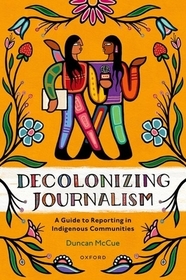
Decolonizing Journalism
A Guide to Reporting in Indigenous Communities
- Publisher's listprice GBP 34.99
-
16 716 Ft (15 920 Ft + 5% VAT)
The price is estimated because at the time of ordering we do not know what conversion rates will apply to HUF / product currency when the book arrives. In case HUF is weaker, the price increases slightly, in case HUF is stronger, the price goes lower slightly.
- Discount 10% (cc. 1 672 Ft off)
- Discounted price 15 044 Ft (14 328 Ft + 5% VAT)
Subcribe now and take benefit of a favourable price.
Subscribe
16 716 Ft

Availability
Only to order.
Why don't you give exact delivery time?
Delivery time is estimated on our previous experiences. We give estimations only, because we order from outside Hungary, and the delivery time mainly depends on how quickly the publisher supplies the book. Faster or slower deliveries both happen, but we do our best to supply as quickly as possible.
Product details:
- Publisher OUP Canada
- Date of Publication 28 October 2022
- ISBN 9780190164263
- Binding Paperback
- No. of pages232 pages
- Size 236x154x14 mm
- Weight 410 g
- Language English
- Illustrations 16 photos, 2 tables 282
Categories
Short description:
Duncan McCue's Decolonizing Journalism: A Guide to Reporting in Indigenous Communities is the only text in Canada that teaches aspiring journalists how to build respectful, reciprocal relationships with Indigenous communities when researching and sharing their stories. Decolonizing Journalism guides students through building critical consciousness vis-Ă -vis Indigenous people and communities, teaches them how to apply their journalistic skills and minds to working with communities, and offers 9 exclusive interviews with Canada's leading Indigenous journalists and podcasters to provide students insight into the histories, processes, and obstacles central to decolonizing journalism and media from the inside out.
MoreLong description:
Recent events including the Truth and Reconciliation Commission and the discovery of mass graves at the sites of former residential schools have brought increased coverage of Indigenous Peoples to Canada's mainstream media outlets. However, there is no guide for current and aspiring journalists to building respectful and reciprocal relationships with Indigenous people and communities when researching and sharing their stories. Written by a leading Indigenous journalist, Duncan McCue, specifically for journalism students in Canada, Decolonizing Journalism delivers practical, up-to-date advice in a guidebook-like text that students will use throughout their studies and careers. Readers will learn how to develop a critical consciousness when engaging with and reporting on Indigenous communities, and will draw insights into the histories, processes, and obstacles central to decolonizing journalism from exclusive interviews with 9 leading Indigenous journalists.
this textbook is an indispensable resource for journalism students... the book offers universal news-gathering lessons beneficial to reporters at any career stage.
Table of Contents:
About the Author
Foreword
Acknowledgements
Contributors
A Brief History of Indigenous Relations in Canada
1) AT THE DESK
1.1 First Contact
1.2 Historical News Stereotypes of Indigenous Peoples
1.3 Beyond Victims and Warriors
1.4 Positive and Negative Stories
1.5 Searching for Solutions
1.6 How to Pitch Stories, Successfully
1.7 "Where Are You From?" - Rethinking Objectivity
2) IN THE FIELD
2.1 Indian Time
2.2 Indigenous Customs and Protocols
2.3 Who Represents the "Indigenous Perspective"?
2.4 White Characters and Indigenous Agency
2.5 Trauma-Informed Reporting
2.6 Story-Takers - How to Deal with 500+ Years of Rage
2.7 Breaking News - Indians Are Funny!
3) ON THE AIR
3.1 Terminology and Lexicon
3.2 Context and Colonial Amnesia
3.3 Accountability, Reciprocity, and Criticism
3.4 Social Media - The New Moccasin Telegraph
3.5 Reconciliation and Journalism
4) TEACHINGS
4.1 Becoming Trauma-Informed - A Conversation with Connie Walker
4.2 Lessons in Humility - A Conversation with Waubgeshig Rice
4.3 "In Love with My People" - A Conversation with Mark Trahant
4.4 Northern Reflections - A Conversation with Juanita Taylor
4.5 Respect and Relationships - A Conversation with Tanya Talaga
4.6 In Pursuit of Truth - A Conversation with Karyn Pugliese
4.7 Punching Up - A Conversation with Tim Fontaine
4.8 The Need for Knowledge-Based Journalism - A Conversation with Merelda Fiddler-Potter
4.9 Asking Hard Questions - A Conversation with Tristan Ahtone
Conclusion: The Last Word
Appendix 1: UNDRIP Articles Relating to Media
Appendix 2: TRC Calls to Action Relating to Media
Appendix 3: OCAP Principles for Indigenous Research and Data Collection
Appendix 4: Residential School Apology
Additional Resources
Bibliography
Index

