

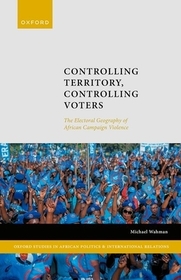
Controlling Territory, Controlling Voters
The Electoral Geography of African Campaign Violence
Series: Oxford Studies in African Politics and International Relations;
- Publisher's listprice GBP 74.00
-
33 411 Ft (31 820 Ft + 5% VAT)
The price is estimated because at the time of ordering we do not know what conversion rates will apply to HUF / product currency when the book arrives. In case HUF is weaker, the price increases slightly, in case HUF is stronger, the price goes lower slightly.
- Discount 10% (cc. 3 341 Ft off)
- Discounted price 30 070 Ft (28 638 Ft + 5% VAT)
Subcribe now and take benefit of a favourable price.
Subscribe
33 411 Ft

Availability
printed on demand
Why don't you give exact delivery time?
Delivery time is estimated on our previous experiences. We give estimations only, because we order from outside Hungary, and the delivery time mainly depends on how quickly the publisher supplies the book. Faster or slower deliveries both happen, but we do our best to supply as quickly as possible.
Product details:
- Publisher OUP Oxford
- Date of Publication 19 October 2023
- ISBN 9780198872825
- Binding Hardback
- No. of pages272 pages
- Size 241x162x20 mm
- Weight 564 g
- Language English 447
Categories
Short description:
In Controlling Territory, Controlling Voters Wahman focuses on the political geography of election violence in Africa, particularly in Zambia and Malawi, building on one important observation: elections in many African countries are highly regional and the support for political parties are rarely nationalized.
MoreLong description:
Violence in election campaigns is common across the African continent and beyond. According to some estimations, most African elections contain some degree of violence and most of this violence happens before elections, during the campaign. While campaign violence is a common problem, it affects citizens differently across localities. When violence and intimidation become an integral part of election campaigns in a locality, they become tools of sub-national authoritarianism that may effectively dismantle local democracy.
This book focuses on the political geography of election violence in Africa, building on one important observation: elections in many African countries are highly regional and the support for political parties are rarely nationalized. Wahman argues that in such environments, campaign violence becomes an important tool used by parties to control and regulate access to space.
Building on a wealth of data and extensive fieldwork in Zambia and Malawi, the author uses a combination of electoral geography analysis, constituency-level election violence data collected from local election monitors, focus group interviews, archival material, and individual-level survey data to show how campaign violence in both countries is used as a territorial tool, predominantly within party strongholds.
Oxford Studies in African Politics and International Relations is a series for scholars and students working on African politics and International Relations and related disciplines. Volumes concentrate on contemporary developments in African political science, political economy, and International Relations, such as electoral politics, democratization, decentralization, the political impact of natural resources, the dynamics and consequences of conflict, and the nature of the continent's engagement with the East and West. Comparative and mixed methods work is particularly encouraged. Case studies are welcomed but should demonstrate the broader theoretical and empirical implications of the study and its wider relevance to contemporary debates. The series focuses on sub-Saharan Africa, although proposals that explain how the region engages with North Africa and other parts of the world are of interest. General Editors Nic Cheeseman, Peace Medie, and Ricardo Soares de Oliveira.
Michael Wahman advances an eloquent theory and offers rich original data that takes territory seriously... This richly detailed and insightful book makes valuable contributions to scholarship on election violence, subnational authoritarianism, and democratization in Africa and beyond... The book's argument and findings point to important questions for future research.
Table of Contents:
Introduction
An Electoral Geography Theory of Campaign Violence
Democracy, Elections, and Electoral Geography in Zambia
Campaign Violence in Zambia
Individual-level Fear, Electoral Geography, and Political Participation in Zambia
Democracy, Elections, and Electoral Geography in Malawi
Election Violence in Malawi
Extending the Argument
Conclusion
Appendix

