

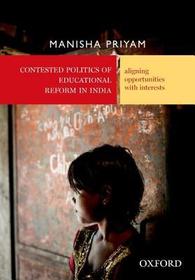
Contested Politics of Educational Reform in India
Aligning Opportunities with Interests
- Publisher's listprice GBP 35.99
-
16 249 Ft (15 475 Ft + 5% VAT)
The price is estimated because at the time of ordering we do not know what conversion rates will apply to HUF / product currency when the book arrives. In case HUF is weaker, the price increases slightly, in case HUF is stronger, the price goes lower slightly.
- Discount 10% (cc. 1 625 Ft off)
- Discounted price 14 624 Ft (13 928 Ft + 5% VAT)
Subcribe now and take benefit of a favourable price.
Subscribe
16 249 Ft

Availability
Only to order.
Why don't you give exact delivery time?
Delivery time is estimated on our previous experiences. We give estimations only, because we order from outside Hungary, and the delivery time mainly depends on how quickly the publisher supplies the book. Faster or slower deliveries both happen, but we do our best to supply as quickly as possible.
Product details:
- Publisher OUP India
- Date of Publication 22 January 2015
- ISBN 9780198098874
- Binding Hardback
- No. of pages320 pages
- Size 221x148x27 mm
- Weight 918 g
- Language English
- Illustrations 15 graphs & charts; 7 photos 0
Categories
Short description:
This book analyses the role of politics in the process of social sector policy reforms in the context of developing countries. It provides a unique analysis of why Indian states are at varying levels of human development despite two decades of federally sponsored policy reforms in education. Substantiating her arguments with statistics, the author gives a local view of how reforms unfold on the ground, close to the lives of poor people for whom this change is meant.
MoreLong description:
This book analyses the role of politics in the process of social sector policy reforms in the context of developing countries. Considered significant in the real world, politics is missed out by the dominant approaches used to design or analyse the policy process. In the small body of literature available, politics is viewed in a negative way-an obstruction which leads to failure. However, if we focus also on cases of success, we find that it works in a far more nuanced and complex way. Specially, if changes are viewed 'downstream' as people experience them, the reform-politics relationship unravels as a deeply contested process.
Comparing the case of educational policy reform in two Indian states, Andhra Pradesh and Bihar, this book finds that unintended policy consequences, building allies amongst teachers, and a preference for collaboration with unions over more conflictual approaches, may have been responsible for better outcomes in Andhra. In comparison, the stagnation in Bihar was on account of weaker policies of teacher management, and elite capture of local institutions of school decentralization. Seeing the change process, in terms of the day-to-day conditions of policy implementation, close to where poor people experience it, helps in understanding the locally embedded nature of power relations. This book engages with the big world or power without necessarily romanticizing the local, or ignoring that leaders may indeed be pursuing political motivations while they seemingly work in the name of the poor.
Table of Contents:
List of Figures and Tables
Preface
List of Abbreviations
Introduction: Understanding the 'Missing' Politics in Educational Reform
1. Theory and Practice of Educational Reform in India: A Review
2. The Context of Change: Centre Sets the Agenda
3. Federal Opportunities, State-level Implementation: The Puzzle of Contrasting Outcomes in Andhra Pradesh and Bihar
4. Reform Opponents: Do Teachers and their Unions Resist the Implementation of Change?
5. Reform Proponents? Contrasting Effects of Educational Decentralization and Community Participation
6. Politics, Schools, and the Poor: A Local View
7. Politics Matters: The Continuing Agenda of Educational Reform
Research Methods Appendix
Glossary
Bibliography
Index
About the Author

