

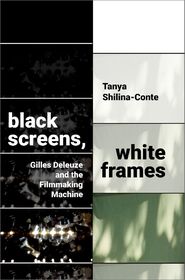
Black Screens, White Frames
Gilles Deleuze and the Filmmaking Machine
- Publisher's listprice GBP 26.99
-
12 185 Ft (11 605 Ft + 5% VAT)
The price is estimated because at the time of ordering we do not know what conversion rates will apply to HUF / product currency when the book arrives. In case HUF is weaker, the price increases slightly, in case HUF is stronger, the price goes lower slightly.
- Discount 10% (cc. 1 218 Ft off)
- Discounted price 10 967 Ft (10 445 Ft + 5% VAT)
Subcribe now and take benefit of a favourable price.
Subscribe
12 185 Ft

Availability
Estimated delivery time: In stock at the publisher, but not at Prospero's office. Delivery time approx. 3-5 weeks.
Not in stock at Prospero.
Why don't you give exact delivery time?
Delivery time is estimated on our previous experiences. We give estimations only, because we order from outside Hungary, and the delivery time mainly depends on how quickly the publisher supplies the book. Faster or slower deliveries both happen, but we do our best to supply as quickly as possible.
Product details:
- Publisher OUP USA
- Date of Publication 3 February 2025
- ISBN 9780197511336
- Binding Paperback
- No. of pages328 pages
- Size 235x157x17 mm
- Weight 458 g
- Language English
- Illustrations 60 b/w photographs 559
Categories
Short description:
Black Screens, White Frames offers a new understanding of cinematic blankness. Drawing on Gilles Deleuze's philosophy and pursuing an affirmative approach to non-images through the concept of the filmmaking machine, Tanya Shilina-Conte shows how absence as a productive mode alters the ways in which we study film.
MoreLong description:
Included in the list of recent notable books by the Visible Evidence Society
Black Screens, White Frames offers a new understanding of cinematic blankness. Drawing on Gilles Deleuze's philosophy, Tanya Shilina-Conte provides a detailed examination of non-images throughout film history. In different arts, including cinema, absence has often been understood in a negative way— as a lack or lacuna, a vacuum or void. To remedy this, Shilina-Conte advances the concept of the filmmaking machine as an abstract art machine in constant production, which shifts our understanding of absence in cinema from negative to generative theorization. In the course of machinic production, dissociation ceases to be a negative characteristic of failure or incapacity and becomes a creative and capacious gesture of artistic experimentation. Shilina-Conte's approach is guided by a film-philosophical methodology and experimental modes of cinema rather than a thematic interpretation of its narrative forms. Further, she argues that blank screens (and their derivatives) function as points of deterritorialization within the filmmaking machine. In each chapter, she demonstrates that black or white screens either instigate relative deterritorializations or engender absolute escapes from narrative regimes in cinema. Blank screens in cinema, as machinic mutations and conditions of possibility, do not represent or symbolize but instead activate what has yet to appear and is still to become. This innovative reconsideration of non-images allows us to perform more nuanced analyses of cinematic modes often overlooked in traditional film criticism. The wide-ranging discussion of canonical and rare examples in Shilina-Conte's book uncovers how absence as a productive process not only alters the ways in which we study cinema but also changes the questions we ask about its history.
An important expansion of Deleuzian cinematic philosophy, Black Screens, White Frames reconceptualizes the "blank" screen as a populated and performative machine. With limpid, compelling writing, Shilina-Conte guides the reader confidently through a generative assemblage of concepts, illuminates their contexts, and tests them on an exciting variety of movies, from early cinema to supercut, that release enfolded powers.
Table of Contents:
Acknowledgments
Fade-In: Introduction. The Filmmaking Machine, or Thirteen Ways of Looking at the Black or White Screen
Chapter 1. Divergent Darkness: The Black Screen in Early Cinema
Chapter 2. Convergent Codes: Fade-ins and Fade-outs as Rational Transitions in Classical Cinema
Chapter 3. The Black or White Screen as a Tool of Deterritorialization in Modern and Experimental Cinema
Chapter 4. One Chapter Less: The Black or White Screen in Minor Cinema
Chapter 5. Folds to Black or White in Minor Cinema and Art Practice
Chapter 6. Alternate Endings: The Black or White Screen in Post-Cinema
Fade-Out: Conclusion. This Video Does Not Exist: The Remix of Black or White Screens and Multimodal Scholarship
Notes
Index

