

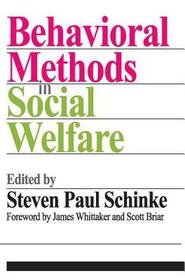
Behavioral Methods in Social Welfare
Helping Children, Adults, and Families in Community Settings
- Publisher's listprice GBP 51.99
-
24 838 Ft (23 655 Ft + 5% VAT)
The price is estimated because at the time of ordering we do not know what conversion rates will apply to HUF / product currency when the book arrives. In case HUF is weaker, the price increases slightly, in case HUF is stronger, the price goes lower slightly.
- Discount 10% (cc. 2 484 Ft off)
- Discounted price 22 354 Ft (21 290 Ft + 5% VAT)
Subcribe now and take benefit of a favourable price.
Subscribe
24 838 Ft

Availability
Estimated delivery time: In stock at the publisher, but not at Prospero's office. Delivery time approx. 3-5 weeks.
Not in stock at Prospero.
Why don't you give exact delivery time?
Delivery time is estimated on our previous experiences. We give estimations only, because we order from outside Hungary, and the delivery time mainly depends on how quickly the publisher supplies the book. Faster or slower deliveries both happen, but we do our best to supply as quickly as possible.
Product details:
- Edition number 1
- Publisher Routledge
- Date of Publication 30 July 2007
- Number of Volumes Paperback
- ISBN 9780202362144
- Binding Paperback
- No. of pages418 pages
- Size 229x152 mm
- Weight 635 g
- Language English 0
Categories
Short description:
Offers positive proof that behaviorism has come of age in social work. This title details a systematic format for both problem intervention and evaluation which produces a more empirically based practice. It provides a different perspective and stimulus for social work practice.
MoreLong description:
"Behavioral Methods in Social Welfare" offers positive proof that behaviorism has come of age in social work. Steven Paul Schinke and the contributors to this volume are social work practitioners who document their attempts to extend the basic tenets of behavioral psychology from the laboratory, clinic, and classroom to the full range of client groups and social problems that make up the practice of social work. In social work education, traditionally to the extent it appeared in the curriculum at all, behavioral content appeared in electives or in courses not focused on practice. It is a true measure of progress that behavioral methods are now visible, integral component of social work education and practice.The authors of each piece in this collection indicate progress in developing an empirically based approach to social work practice. Despite the impressive documentation contained in the present volume, no conclusive evidence as to the effectiveness of behavioral methods exists. What behavioral methods do offer, however, is a systematic format for both problem intervention and evaluation that, over time, should produce a more empirically based practice. A promising sign, well documented in the present effort, is the facility with which this book has subjected practice procedures to the rigor of research and evaluation.This blending of clinical practice and research develops the sense of competence that student-practitioners acquire in understanding and controlling both the art and science of their clinical practice. Steven Schinke and his colleagues offer a series of "snapshots" of important work in process. Their collective portrait provides a fresh perspective and new stimulus for all social work practice, as well as an affirmation that disciplined, responsive, and sensitive social work intervention can make a difference in the lives of people.
MoreTable of Contents:
AcknowledgmentsAuthorsForeword: James K. Whittaker and Scott Briar Introduction: Behavioral Methods in Social WorkI. METHODS FOR CHILDREN AND FAMILIES1. Groups for Antisocial Children:John S. Wodarski 2. Parents as Agents for Behavior Change:Elsie M. Pinkston, Benjamin S. Friedman, and Richard A. Polster 3. Reaching Underachievers:Richard A. Polster, Mary Ann Lynch, and Elsie M. Pinkston 4. Social Competence in Adolescence:Lewayne D. Gilchrist. 5. Contracts in Foster Care:Theodore J. Stein and Eileen D. Gambrill 6. Crisis Intervention with Youths:Edmund T. Dimock 7. Treatment of Child Abuse:Robert F. Schilling, II II. BEHAVIORAL METHODS WITH ADULTS8. Women and Self-Criticism:Sharon B. Berlin 9. Assertiveness Training for Women:Cheryl A. Richey 10. Sexual Dysfunction and Cognitions:Wayne D. Duehn and Nazneen Sada Mayadas 11. Control of Addictions:Betty J. Blythe 12. Helping Mentally Retarded Persons Get Jobs:Richard M. Grinnell, Jr. and Alice Lieberman 13. Social Interactions in Nursing Homes:Raymond M. Berger III. PROFESSIONAL COMPETENCE AND ACCOUNTABILITY14. Developing Skills for the Interview:Jeffrey L. Edleson and Sheldon D. Rose 15. Preparing for Marital Counseling in Nontraditional Settings:Stanley Witkin 16. Behavioral Methods in Primary Health Care:William H. Butterfield and Judith Werking 17. Individual Case Evaluation:Steven Paul Schinke 18. Evaluation at the Community-Program Level:Richard L. Gorsuch ReferencesAuthor IndexSubject Index
More
