

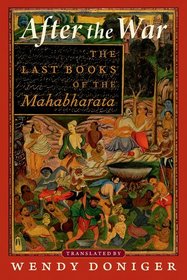
After the War
The Last Books of the Mahabharata
- Publisher's listprice GBP 93.00
-
41 989 Ft (39 990 Ft + 5% VAT)
The price is estimated because at the time of ordering we do not know what conversion rates will apply to HUF / product currency when the book arrives. In case HUF is weaker, the price increases slightly, in case HUF is stronger, the price goes lower slightly.
- Discount 10% (cc. 4 198 Ft off)
- Discounted price 37 791 Ft (35 991 Ft + 5% VAT)
Subcribe now and take benefit of a favourable price.
Subscribe
41 989 Ft

Availability
Estimated delivery time: In stock at the publisher, but not at Prospero's office. Delivery time approx. 3-5 weeks.
Not in stock at Prospero.
Why don't you give exact delivery time?
Delivery time is estimated on our previous experiences. We give estimations only, because we order from outside Hungary, and the delivery time mainly depends on how quickly the publisher supplies the book. Faster or slower deliveries both happen, but we do our best to supply as quickly as possible.
Product details:
- Publisher OUP USA
- Date of Publication 12 September 2022
- ISBN 9780197553398
- Binding Hardback
- No. of pages192 pages
- Size 143x216x14 mm
- Weight 327 g
- Language English 220
Categories
Short description:
A new translation of the end of the Mahabharata, depicting the final years of the surviving heroes, their debates about the justice of war and the meaning of life, their ultimate deaths, and their experiences of heaven and hell. The author, a distinguished translator of Sanskrit texts, puts the text into clear, flowing, contemporary prose, with a comprehensive but unintrusive critical apparatus. This book will delight general readers and enlighten students of Indian civilization and of great world literature.
MoreLong description:
After the War is a new translation of the final part of the Mahabharata, the great Sanskrit Epic poem about a devastating fraternal war. In this aftermath of the great war, the surviving heroes find various deaths, ranging from a drunken debacle in which they kill many of their own comrades to suicide through meditation and, finally, magical transportation to both heaven and hell. Bereaved mothers and widows on earth are comforted when their dead sons and husbands are magically conjured up from heaven and emerge from a river to spend one glorious night on earth with their loved ones. Ultimately, the bitterly opposed heroes of both sides are reconciled in heaven, but only when they finally let go of the vindictive masculine pride that has made each episode of violence give rise to another. Throughout the text, issues of truth and reconciliation, of the competing beliefs in various afterlives, and of the ultimate purpose of human life are debated.
This last part of the Mahabharata has much to tell us both about the deep wisdom of Indian poets during the centuries from 300 BCE to 300 CE (the dates of the recension of this enormous text) and about the problems that we ourselves confront in the aftermath of our own genocidal and internecine wars. The author, a distinguished translator of Sanskrit texts (including the Rig Veda, the Laws of Manu, and the Kamasutra), puts the text into clear, flowing, contemporary prose, with a comprehensive but unintrusive critical apparatus. This book will delight general readers and enlighten students of Indian civilization and of great world literature.
An independently printed and affordable translation that gathers the concluding parvans, or books of the epic, for a general readership...Doniger's rendering is smooth, readable, and appealing without artificial or anachronizing reduction in the formal tone of the text.
Table of Contents:
Contents
Acknowledgements
Introduction
Part I: The Text and the Story
The Older Generation: The Birth of Pandu, Dhritarashtra, and Vidura
The Birth of the Sons of Pandu and Kunti
The Marriage of Draupadi
Part II: The Last Books of the Mahabharata
Book Fifteen (Ashramavasika, Living in the Ashram) and Book Eleven (Stri, The Women)
Book Sixteen (Mausala, The Battle of the Clubs), Gandhari's Curse, and Buddhist and Jain Variants
Book Seventeen (Mahaprasthanika, The Great Departure) and Yudhishthira's Dog
Book Eighteen (Svargarohana, Climbing to Heaven) and the Transfer of Karma
Part III: The Meaning of the End of the Story
Death and Transfiguration
Theodicy and the Cause of Devastating War
Vengeful Pride as a Cause of War
Part IV: An Apology for My Translation
Criticizing the Critical Edition, and Leaving Key Words in Sanskrit
The Problem of Adjectives and Epithets
The Poet and his Formulas, or, Parry and Lord to the Rescue
The Translation
Book Fifteen, Ashramavasika Parvan, The Book of Living in the Ashram
Chapters Twenty-Six to Forty-Seven
Preface to Book Fifteen
Part One: Living in the Ashram
Chapter 26: Narada Arrives and Predicts Dhritarashtra's Arrival in Heaven
Chapter 27: Narada Predicts Dhritarashtra's Worlds
Chapter 28: The Pandavas Worry about Their Mother and Dhritarashtra
Chapter 29: The Pandavas Set Out for the Forest
Chapter 30: The Pandavas Enter the Forest with their Army
Chapter 31: The Pandavas meet Kunti, Dhritarashtra, and Gandhari
Chapter 32: Sanjaya, the Bard, Introduces the Pandavas to the Hermits
Chapter 33: Vidura Enters the Body of Yudhishthira
Chapter 34: Yudhishthira Distributes Gifts and Vyasa Arrives
Chapter 35: Vyasa Explains Who Vidura Was and Offers to Perform a Miracle
Part Two: The Vision of the Sons
Chapter 36: Narada Arrives and Dhritarashtra Grieves
Chapter 37: Gandhari Tells Vyasa of the Women's Grief
Chapter 38: Kunti Tells Vyasa How She Abandoned Karna
Chapter 39: Vyasa Explains the Incarnation of the Gods as Warriors
Chapter 40: The Dead Warriors Appear Out of the Ganges
Chapter 41: The Returned Warriors Depart and Their Wives Enter the Ganges
Chapter 44: The Pandavas Take Leave of Dhritarashtra, Gandhari, and Kunti
Part Three: The Arrival of Narada
Chapter 45: Narada Arrives and Tells Yudhishthira How Dhritarashtra, Gandhari, and Kunti Died
Chapter 46: Yudhishthira Mourns for the Dead and Curses Kingship
Chapter 47: Narada Explains the Fire and Yudhishthira Performs the Funerals
Book Sixteen, Mausala Parvan, The Book of the Battle of the Clubs
Preface to Book Sixteen
Chapter 1: Yudhishthira Sees Omens and Learns about the Battle of the Clubs
Chapter 2: The Sages Curse the Vrishnis and the Club Appears
Chapter 3: Omens Appear and Krishna Proclaims a Pilgrimage
Chapter 4: The Vrishnis Go on a Pilgrimage and a Fight Breaks Out
Chapter 5: Krishna and Balarama Depart and Die
Chapter 6: Arjuna Goes to Dvaraka
Chapter 7: Arjuna Visits Vasudeva, Who Grieves and Vows to Die
Chapter 8: Arjuna Leads the Vrishni Women Out of Dvaraka and Bandits Attack
Chapter 9. Arjuna Visits Vyasa and Yudhishthira
Book Seventeen, Mahaprasthanika Parvan, The Book of the Great Departure
Preface to Book Seventeen
Chapter 1. The Pandavas Install the Kings, Depart and Encounter Fire
Chapter 2. Draupadi, Sahadeva, Nakula, Arjuna, and Bhima Fall
Chapter 3. Yudhishthira Goes to Heaven, With a Dog
Book Eighteen, Svargarohana Parvan, The Book of Climbing to Heaven
Preface to Book Eighteen
Chapter 1. Yudhishthira Reaches Heaven and Encounters Duryodhana
Chapter 2. Yudhishthira Goes to Hell and Meets His Brothers and Draupadi
Chapter 3. Yudhishthira Remains in Heaven and Bathes in the Heavenly Ganges
Chapter 4. Yudhishthira in Heaven Meets the Reborn Warriors from Both Sides
Chapter 5. Everyone Becomes the Gods They Always Were
Appendices
Appendix One: Adjectives Applied to Several Characters
Appendix Two: Names and Epithets of Central Characters
Appendix Three: Minor Characters and Classes of Beings
Appendix Four: The Earlier Lives of the Protagonists of the Last Books of the Mahabharata
Appendix Five: Bibliography for Further Reading
Appendix Six: Technical Textual Notes

