

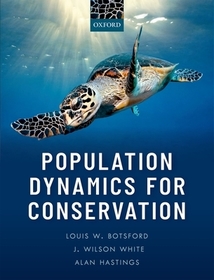
Population Dynamics for Conservation
-
10% KEDVEZMÉNY?
- A kedvezmény csak az 'Értesítés a kedvenc témákról' hírlevelünk címzettjeinek rendeléseire érvényes.
- Kiadói listaár GBP 52.00
-
23 478 Ft (22 360 Ft + 5% áfa)
Az ár azért becsült, mert a rendelés pillanatában nem lehet pontosan tudni, hogy a beérkezéskor milyen lesz a forint árfolyama az adott termék eredeti devizájához képest. Ha a forint romlana, kissé többet, ha javulna, kissé kevesebbet kell majd fizetnie.
- Kedvezmény(ek) 10% (cc. 2 348 Ft off)
- Kedvezményes ár 21 130 Ft (20 124 Ft + 5% áfa)
Iratkozzon fel most és részesüljön kedvezőbb árainkból!
Feliratkozom
23 478 Ft

Beszerezhetőség
Megrendelésre a kiadó utánnyomja a könyvet. Rendelhető, de a szokásosnál kicsit lassabban érkezik meg.
Why don't you give exact delivery time?
A beszerzés időigényét az eddigi tapasztalatokra alapozva adjuk meg. Azért becsült, mert a terméket külföldről hozzuk be, így a kiadó kiszolgálásának pillanatnyi gyorsaságától is függ. A megadottnál gyorsabb és lassabb szállítás is elképzelhető, de mindent megteszünk, hogy Ön a lehető leghamarabb jusson hozzá a termékhez.
A termék adatai:
- Kiadó OUP Oxford
- Megjelenés dátuma 2019. október 1.
- ISBN 9780198758372
- Kötéstípus Puhakötés
- Terjedelem354 oldal
- Méret 245x188x16 mm
- Súly 746 g
- Nyelv angol 100
Kategóriák
Rövid leírás:
Provides a coherent overview of the theory of single population dynamics, discussing concepts such as population variability, population stability, population viability/persistence, and harvest yield while later chapters address specific applications to conservation and management.
TöbbHosszú leírás:
The management and conservation of natural populations relies heavily on concepts and results generated from models of population dynamics. Yet this is the first book to present a unified and coherent explanation of the underlying theory. This novel text begins with a consideration of what makes a good state variable, progressing from the simplest models (those with a single variable such as abundance or biomass) to more complex models with other key variables of population structure (including age, size, life history stage, and space). Throughout the book, attention is paid to concepts such as population variability, population stability, population viability/persistence, and harvest yield. Later chapters address specific applications to conservation such as recovery planning for species at risk, fishery management, and the spatial management of marine resources.
Population Dynamics for Conservation is suitable for graduate-level students. It will also be valuable to academic and applied researchers in population biology. This overview of population dynamic theory can serve to further their population research, as well as to improve their understanding of population management.
This primer on population dynamics theory and its applications introduce the reader to the mathematical tools necessary to construct analytical models of plant and animal population dynamics ... The book will be useful as either a textbook for students or as a reference for experienced researchers.
Tartalomjegyzék:
Philosophical approach to population modeling
Simple population models
Linear, age-structured models and their long-term dynamics
Age-structured models: short-term transient dynamics
Size-structured models
Stage-structured models
Age-structured models with density-dependent recruitment
Age-structured models in a random environment
Spatial population dynamics
Applications to conservation biology
Population models in marine conservation
Thinking about populations

