

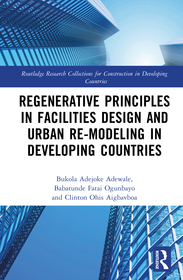
Regenerative Principles in Facilities Design and Urban Re-modeling in Developing Countries
Series: Routledge Research Collections for Construction in Developing Countries;
- Publisher's listprice GBP 175.00
-
79 012 Ft (75 250 Ft + 5% VAT)
The price is estimated because at the time of ordering we do not know what conversion rates will apply to HUF / product currency when the book arrives. In case HUF is weaker, the price increases slightly, in case HUF is stronger, the price goes lower slightly.
- Discount 20% (cc. 15 802 Ft off)
- Discounted price 63 210 Ft (60 200 Ft + 5% VAT)
- Discount is valid until: 30 June 2026
Subcribe now and take benefit of a favourable price.
Subscribe
71 111 Ft

Availability
Estimated delivery time: In stock at the publisher, but not at Prospero's office. Delivery time approx. 3-5 weeks.
Not in stock at Prospero.
Why don't you give exact delivery time?
Delivery time is estimated on our previous experiences. We give estimations only, because we order from outside Hungary, and the delivery time mainly depends on how quickly the publisher supplies the book. Faster or slower deliveries both happen, but we do our best to supply as quickly as possible.
Product details:
- Edition number 1
- Publisher Routledge
- Date of Publication 4 March 2026
- ISBN 9781041039808
- Binding Hardback
- No. of pages366 pages
- Size 234x156 mm
- Weight 840 g
- Language English
- Illustrations 19 Illustrations, black & white; 4 Halftones, black & white; 15 Line drawings, black & white; 1 Tables, black & white 684
Categories
Short description:
This book explores regenerative architecture as a viable approach for the design of facilities for urban remodelling in developing countries.
MoreLong description:
In the face of rapid urbanization and environmental challenges, the developing world stands at a crossroads. Conventional sustainable design, often modelled on Global North precedents, is proving insufficient to address the deep-seated infrastructural and socio-economic complexities of these unique contexts. This book argues for a radical shift from simply minimizing harm to actively healing and restoring our communities and ecosystems through regenerative architecture.
Moving beyond theory, this work provides a critical and practical roadmap for applying regenerative principles specifically in the challenging environments of developing nations. We delve into the core of what makes regeneration different, showcasing how it can produce net-positive energy and water systems, enhance biodiversity, foster social equity, and create economic value where it is needed most.
The heart of this book lies in its actionable insights and real-world evidence. Through a series of detailed case studies-from innovative adaptive reuse in Ghana and decentralized renewable systems in Rwanda to community-driven projects in South Africa, we demonstrate viable solutions. These are contrasted with lessons from pioneering examples in Sweden, the UK, and Canada, not as blueprints to copy, but as sources of adaptable strategies.
A significant focus is given to a deep-dive case study of Nigeria, offering a nuanced examination of its colonial architectural legacy, current urban pressures, and the emergent regenerative strategies that blend vernacular wisdom with modern innovation.
This book is more than a reference; it is a call to action. It provides policymakers with frameworks for supportive regulations, offers practitioners design strategies and performance metrics, and equips students and researchers with a comprehensive conceptual foundation. By championing an approach that is both context-sensitive and aspirational, this book serves as an essential guide for anyone committed to building resilient, vibrant, and equitable urban futures in the developing world and beyond.
MoreTable of Contents:
1. Background Information of the Book. 2. Overview of Regenerative Architecture. 3. Benefits of Regenerative Architecture. 4. Adapting Regenerative Architecture Principles for Facilities Design and Urban Remodelling. 5. Critical Success Factors for Implementing Regenerative Principles in Facilities Design and Urban Remodeling in Developing Countries. 6. Contextual Challenges in Regenerative Architecture Principles Application in Facilities Design and Urban Remodelling for Developing Countries Development. 7. Case Studies and Best Practices of Successful Regenerative Design Applications in Urban Facilities in Developed Countries. 8. Case Studies and Best Practices of Successful Regenerative Design Applications in Urban Facilities in Developing Countries. 9. Case Study of Nigeria. 10. Conclusions and Recommendations.
More
