

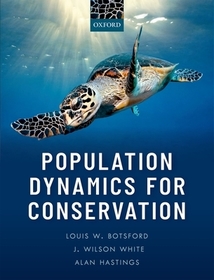
Population Dynamics for Conservation
- Publisher's listprice GBP 52.00
-
23 478 Ft (22 360 Ft + 5% VAT)
The price is estimated because at the time of ordering we do not know what conversion rates will apply to HUF / product currency when the book arrives. In case HUF is weaker, the price increases slightly, in case HUF is stronger, the price goes lower slightly.
- Discount 10% (cc. 2 348 Ft off)
- Discounted price 21 130 Ft (20 124 Ft + 5% VAT)
Subcribe now and take benefit of a favourable price.
Subscribe
23 478 Ft

Availability
printed on demand
Why don't you give exact delivery time?
Delivery time is estimated on our previous experiences. We give estimations only, because we order from outside Hungary, and the delivery time mainly depends on how quickly the publisher supplies the book. Faster or slower deliveries both happen, but we do our best to supply as quickly as possible.
Product details:
- Publisher OUP Oxford
- Date of Publication 1 October 2019
- ISBN 9780198758372
- Binding Paperback
- No. of pages354 pages
- Size 245x188x16 mm
- Weight 746 g
- Language English 100
Categories
Short description:
Provides a coherent overview of the theory of single population dynamics, discussing concepts such as population variability, population stability, population viability/persistence, and harvest yield while later chapters address specific applications to conservation and management.
MoreLong description:
The management and conservation of natural populations relies heavily on concepts and results generated from models of population dynamics. Yet this is the first book to present a unified and coherent explanation of the underlying theory. This novel text begins with a consideration of what makes a good state variable, progressing from the simplest models (those with a single variable such as abundance or biomass) to more complex models with other key variables of population structure (including age, size, life history stage, and space). Throughout the book, attention is paid to concepts such as population variability, population stability, population viability/persistence, and harvest yield. Later chapters address specific applications to conservation such as recovery planning for species at risk, fishery management, and the spatial management of marine resources.
Population Dynamics for Conservation is suitable for graduate-level students. It will also be valuable to academic and applied researchers in population biology. This overview of population dynamic theory can serve to further their population research, as well as to improve their understanding of population management.
This primer on population dynamics theory and its applications introduce the reader to the mathematical tools necessary to construct analytical models of plant and animal population dynamics ... The book will be useful as either a textbook for students or as a reference for experienced researchers.
Table of Contents:
Philosophical approach to population modeling
Simple population models
Linear, age-structured models and their long-term dynamics
Age-structured models: short-term transient dynamics
Size-structured models
Stage-structured models
Age-structured models with density-dependent recruitment
Age-structured models in a random environment
Spatial population dynamics
Applications to conservation biology
Population models in marine conservation
Thinking about populations

